Test review DrivOlution XPENG G6 RWD Long Range
Test report
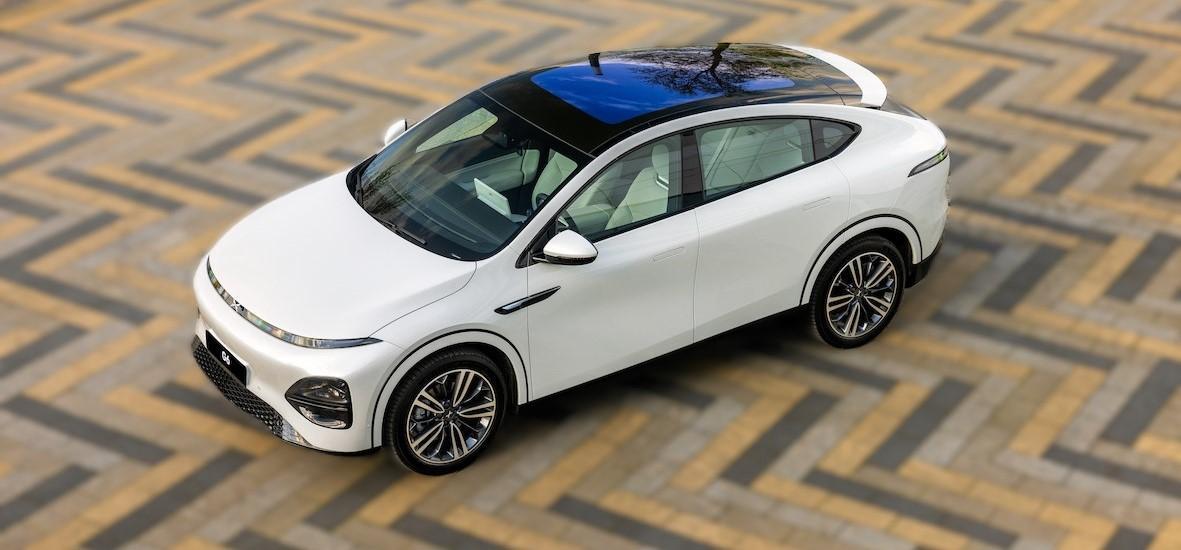
A while ago, we got to know the XPENG G9 AWD Performance. A test that delighted us immensely. Today, we are introduced to its "smaller brother", the XPENG G6. Although this G6 is not that small. It is a handsome-looking SUV that still has something to offer. XPENG contributes to an innovative approach to mobility using advanced technologies.
This XPENG G6 comes in three versions namely the G6 RWD Standard Range, the G6 RWD Long Range and the performance G6 AWD Performance. And as the names suggest, the difference is in the battery size: the Standard version features a 66 kWh battery pack while the Long Range and Performance have an 87.5 kWh battery pack. In addition, the Performance has all-wheel drive and a Dual Motor.
The Long Range version is the one made available.
As always, we focus on driving range and consumption.
General information
- SUV
- Mass in running order 2.100 kg
- Number of seats 5
- LxWxH (mm) 4800 4.753 x 1.920 x 1.650
- Test vehicle price (VATi) from 47,990 euros
- Cargo volume 571L/1.374L (max)
- Cargo volume frunk 0L
- Tow Hitch Possible yes (1.500 kg towing braked/750 kg towing onbraked)
- Warranty : for all sales in calendar year 2024, the warranty period is 7 years or 160,000 km
Driveline
- BEV (Battery Electric Vehicle)
- Battery type Lithium-ion (NMC)
- 92 kWh battery capacity (87.5 kWh usable)
- Power 210 kW (286 hp)
- Torque 440 Nm
- RWD (rear wheel drive)
- Architecture 800 V
- EV-specific platform - XPENG SEPA 2.0
- Heat pump - X-HP 3.0 Intelligent Thermal Management System
- Vehicle-to-Load (V2L) : 3,3 kW AC
Consumption/driving range (WLTP) (CoC)
- Combined consumption 17,5 kWh/100 km
- Combined driving range 570 km
- Driving range city 773 km
Recharging information
- Internal onboard charger 11 kW
- Charging port location - rear right
- Charge Power AC 11 kW
- Charge Power DC 280 kW max.
- AC : 0 charge
- DC : 1 charge
Test track (102,3 km)
- Non-urban (42,2 km) 10,7 kWh/100 km
- Motorway (40,0 km) 13,2 kWh/100 km
- City (20,1 km) 12,5 kWh/100 km
- Combined 12,1 kWh/100 km
Test results (618 km)
- Non-urban 12,5 kWh/100 km
- Motorway14,0 kWh/100 km
- City 12,5 kWh/100 km
- Mix 13,5 kWh/100 km
- Combined 13,5 kWh/100 km
Test data
Test drivers
Johan Stevens
618 Testkilometers
Driveline
Latest generation EV platform SEPA 2.0
The XPENG G6 sits on the latest generation of XPENG's lightweight and strong EV platform SEPA 2.0. Besides lower weight for longer range, this also means torsional rigidity as strong as 41,600 N-m/deg, representing an 83% increase in rigidity compared to our previous builds. More than 300 components are integrated into one, for greater impact resistance, better weight management and better protection.
Versions
The XPENG G6 available in the following versions:
- The G6 RWD Standard Range: if range is not the main argument in your decision then this one is a suitable choice. It has the smallest battery of 69.0 kWh (66.0 kWh usable) LFP (lithium iron phosphate) battery. Good for an output of 190 kW (258 hp) and 440 Nm of torque. The Standard Range version is rear-wheel-drive. You will get 435 km (WLTP) far with this version.
- the G6 RWD Long Range: this version focuses mainly on maximum driving range and this due to its larger battery of 92.0 kWh of which 87.5 kWh is usable. It is driven on the rear wheels. Power is 210 kW (286 hp) and torque is 440 Nm. The electric driving range is 570 km (WLTP).
- The G6 AWD Performance: the top version just like the G9!The Performance version features the same battery pack as the Long Range version. Propulsion is on all four wheels and this version has two engines. This increases power to 350 kW (476 hp) and torque of 660 Nm will theoretically get you 550 km (WLTP).
More information on the different versions of the XPENG G6 can be found here XPENG - Official Website | XPENG Motors – XPENG
Battery capacity (usable) - 66.0 kWh or 87.5 kWh
Depending on the version you choose, you opt for the 75.8 kWh (Standard Range version) or the 93.1 kWh battery (Long Range and Performance version). Interesting when you have that choice. This allows you to choose the version that best suits your needs.
Architecture - 800 V
Like the G9, the G6 features the 800V architecture that enables 'ultra-fast charging'.
Driving modes - four
The XPENG G6 offers four driving modes: Eco, Standard, Sport and Individual.
- Standard: in this mode, power response is medium and the suspension leads to a good balance between range and driving performance.
- Eco: in this mode, efficiency is paramount. Power response is slower, increasing your range.
- Sport: choose this mode if you want sporty driving. Power response is faster and a low suspension provides a superior driving experience.
- Individual: customised driving mode.
During the test week, we mainly used Eco and Standard driving modes.
Vehicle-to-Load (V2L)
Max power: 3.3 kW AC (230 V socket of charging port).
Recuperation
You have to choose the level (levels) of braking energy recuperation via the central screen.You can choose from the following levels: low/medium/high/X-PEDAL. The latter effectively represents the principle of One-Pedal-Driving. You use the power pedal to both accelerate and decelerate. Once you have mastered the principle, this works pleasantly and this especially in city traffic. Personally, I still prefer the paddles on the steering wheel. It makes it easier if you want to experiment with the different levels.
Consumption
The results - general
After 618 km, we arrive at a combined consumption of 13.5 kWh/100 km and this spread over 15 recorded trips. Based on the usable battery capacity of 87.5 kWh, this is enough for a driving range of 648 km*. The average outside temperature of during the test period was 16 °C.
The results - by road type
- As always, most of the trips were made on motorways (8 of 15 trips): it yielded an average consumption of 14.0 kWh/100 km. Good for a driving range of 625 km*.
- Outside the city, on secondary roads, we did 3 trips. This resulted in a combined consumption of 12.5 kWh/100 km. If you can maintain this consumption, you can cover 700 km*.
- Only once did we venture into city traffic: here we stranded on a consumption of 12.5 kWh/100 km. In terms of driving range, this means 700 km*.
- In addition, it did 3 more trips that are a mix of motorway and secondary roads. It gives a consumption result of 13.5 kWh/100 km. This consumption gives a driving range of 648 km*.
- The lowest realised consumption is 10.7 kWh/100 km and the highest is 16.4 kWh/100 km.
The results - by driving mode
Following the DrivOlution DNA of efficient driving, Eco drive mode is our favourite.
- In 10 of the 15 trips, we chose Eco driving mode. It yielded a combined consumption of 13,0 kWh/100 km.
- Standard driving mode (4 out of 15 trips) yields a consumption of 14,9 kWh/100 km.
- the Sport driving mode we only tried out. It yields consumption of 12.4 kWh/100 km respectively. Normally, this is a short drive so it cannot really be called representative.
*The stated driving range is a theoretical calculation based on the usable battery capacity. This is always a snapshot. All kinds of factors such as weather conditions, use of air conditioning, topography, traffic density and your own driving style can influence this.
Test track
Consumption results - general
How does the XPENG G6 RWD Long Range perform on our 102.3km test track? The results are as follows. Average consumption comes to 12.1 kWh per 100 km. Based on the usable battery capacity of 87.5 kWh, this results in an electric range of 723 km*. During the test, the average outside temperature was 17°C. We drove the course without climate control.
Consumption results - by road type
- On the non-urban (secondary roads) trip of 42.2 km, the trip computer recorded consumption of 10.7 kWh/100 km. If you can maintain this consumption, this will get you 818 km* on a charge.
- during the 40.0 km motorway trip, consumption rises to 13.2 kWh/100 km. This results in an electric driving range of 663 km*.
- city drive of 20 km yields an average consumption of 12.5 kWh/100 km. This is good for an electric driving range of 700 km*. During the city drive, we used X-PEDAL (OPD = One-Pedal-Driving).
Driving range evolution
The range at the start of the test track was 488 km. After the out-of-town drive, the first part of the test course, we had a range of 599 km. An increase in driving range of 111 km. The highway drive reduced this to 458 km. After the city drive, 436 km remained. So the total drive of 102.3 km cost us 52 km of driving range. This is all based on the dynamic driving range. Worth noting is the drop in SoC (State of Charge): from 77% to 63%.
*The stated driving range is a theoretical calculation based on the usable battery capacity. This is always a snapshot. All kinds of factors such as weather conditions, use of air conditioning, topography, traffic density and your own driving style can influence this.
We strive to drive as efficiently as possible by making maximum use of cruise control (constant speed) and by anticipating traffic situations as much as possible. The speed on motorways is 110 km/h. Energy consumers (such as air conditioning) are switched off when weather conditions permit. In addition, we choose the most efficient driving mode (Eco), if available.
Recharging
Internal on-board charger
The XPENG G6 RWD Long Range features an 11-kW internal on-board charger. The DC charging capacity is up to 280 kW.
Charges
We have just one charge (DC) behind us. Below is the information from the charge
- Charging type: DC
- Charging time (hh:mm): 00:26
- Charged volume: 59.50 kWh
- SoC: from 15% to 80%
- Driving range (start/end of charging session): 86 km to 478 km
Information charging process - for the driver
As a driver, you are sufficiently informed about the evolution of the charging process. You can read the following information on the screen:
- Estimated charging time (hh:mm)
- Rated charging power (kW)
- Estimated driving range (km)
- Voltage (V)
- Ampere (A)
Obviously, charging time depends on the SoC (State of Charge) at the start of charging, the outdoor temperature and the temperature of the battery.
Driving range
The graph below shows the evolution of the driving range during different trips. It is clear that the evolution of driving range is highly dependent on topography, trip profile, weather conditions, selected speed, driving mode and so on. Your driving style is and always will be an important factor.
Drive and comfort
Driving
This XPENG G6 RWD Long Range drives more than comfortable. Quiet and noiseless as you would expect from an electric vehicle. Depending on the driving mode selected, it offers enough power for everyday driving.
Seat position
Excellently adjustable and easy to save. Indeed, with every change you make, you are asked if you want to save the changes. When getting out, the seat moves backwards.This facilitates boarding. The last position is then set. Good lateral support.
Operating
We are getting used to the fact that the central display plays an important role in vehicle operation. We are talking specifically about functions such as climate control, the radio, adjusting the mirrors, selecting driving modes and so on. With both advantages and disadvantages. Good thing there is a quick menu for the most important functions. The driver display contains the most important information.
Displays
There's no getting around it: a modern car contains a large number of screens. Such is the case with the XPENG G6:
- High-resolution LCD screen -10.25" for the driver: here you will find the most important information such as driving range, consumption, SoC, driving mode, ...
CID 14.96" + Co-pilot screen: all other functions are grouped here.
I don't need to tell you that you need some time to learn all the setting options.
Space - modular
Luggage space ranges from 571 L to 1,374 L when the rear seats are folded down. Unlike the G9, the G6 does not have a front luggage compartment (frunk).
Finish - fine
The finish of the XPENG G6 is outstanding. Everything exudes quality.
ADAS (Advanced Driving Assist Systems)
XPILOT 2.5
Like its big brother, the G9, this G6 features a considerable number of sensors and radars. All this results under XPILOT.
- NVIDIA® Orin-X processor
- 5 high-resolution millimetre wave radars
- 2 Ultrasonic sensors
- 12 cameras including fatigue recognition (DSM)
XPILOT - driving includes Adaptive Cruise Control (ACC), Lane Centering Control (LCC), Adaptive Turning Control (ATC), Active Lane Change (ALC) and automatic speed limiter.
XPILOT - parking includes enhanced automatic parking assistance (EAP 2.0), Auto Exit Parking Assist (AEP), parking assistance with 360° camera, remote parking assistance (RPA).
XPILOT - safety ifeatures Driver Monitoring System (DMS), Forward Distance Monitoring (FDM), Front Collision Warning (FCW), autonomous emergency braking system, Traffic Sign Recognition (TSR), Intelligent High Beam (IHB), Blind Spot Detection (BSD), Door Opening Warning (DOW), Lane Departure Warning (LDW), Lane Keeping Assist (LKA), Emergency Lane Keeping (ELK), Rear Collision Warning (RCW) and Rear Cross-Traffic Alert (RCTA).
Don't forget to mention that this XPENG G6 features seven airbags.Moreover, the vehicle scores five stars on the EuroNCAP.
Just to mention that driving assistance systems work quite well. Keep in mind that speed limits are not always correct. Being alert and not blindly following the systems remains the message.
Driving range simulation (km) based on trip consumption (kWh/100 km) and road type
Based on trip consumption and usable battery capacity, we can simulate the driving range. Although this is always a snapshot, it gives a clear picture of how far you could theoretically drive at a given consumption. Of course, various factors can influence these results.
Comparison WLTP/test results DrivOlution
Comparing the consumption results achieved with the manufacturer's WLTP figures, we score well both in terms of consumption and driving range. An efficient driving style pays off.