Test review DrivOlution smart #5 BRABUS
Test report
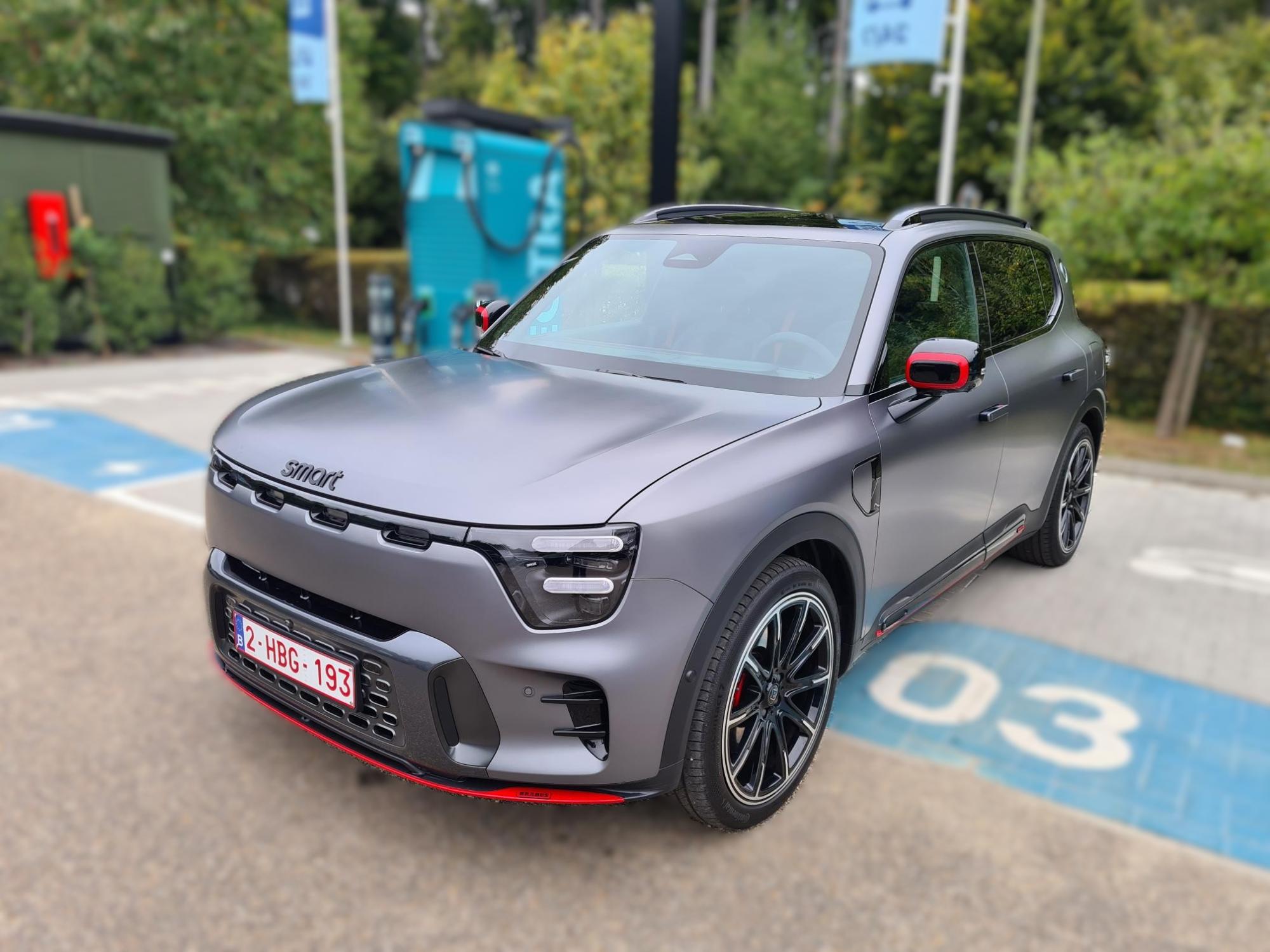
smart #5 BRABUS: The power of silence — or the silence of power.
The smart #5 is the latest addition to the smart family and the brand's first full-fledged SUV. A new chapter in the brand's evolution. What once began as a city icon with compact dimensions is now growing into a full-fledged electric SUV with distinct sporting ambitions. In this BRABUS version, smart combines its advanced 800V technology with impressive performance, a substantial battery capacity and a design that clearly flexes its muscles.
We were given the opportunity to test drive the smart #5 BRABUS for a week, which is the most powerful version available. As always, we were curious about the results in terms of fuel consumption and driving range. However, it turned out to be a bit of a challenge to keep our right foot under control – not easy with 646 hp at our disposal.
Discover below how this powerhouse pleasantly surprised us!
General
- SUV
- Number of seats 5
- Mass in running order 1.730 kg
- LxWxH (mm) 4.695 x 1.920 x 1.705
- Price test vehicle (VTAi) 62.680, - euro (configuration)
- Boot capacity 630 L / 1.530 L (max)
- Cargo volume frunk 72 L
- Tow bar possible (1.600 kg braked - 750 kg unbraked)
- Warranty : 8 years or 200,000 km, retaining at least 70% of the original battery capacity.
Driveline
- BEV (Battery Electric Vehicle)
- Battery type Lithium-ion (NMC)
- 100 kWh Battery capaciteit (94 kWh usable)
- Power 475 kW (646 hp)
- Torque 710 Nm
- AWD
- Architecture 800 V
- EV-specific platform - GEELY SEA3/PMA2
Consumption/driving range (WLTP)
- Combined consumption 19,0 kWh/100 km
- Combined driving range 540 km
- Driving range city --- km
Charging information
- Internal onboard charger 11 kW - 22 kW (from Pro+)
- Charging port rear left
- Charging capacity AC 22 kW (11 kW Pro)
- DC charging capacity up to 400 kW (150 kW Pro)
- AC : 1 charge
- DC : 1 charge
Test track
- Non-urban (40,5 km) 13,6 kWh/100 km
- Motorway (41,4 km) 19,2 kWh/100 km
- City (20,6 km) 12,8 kWh/100 km
- Combined 15,2 kWh/100 km
Consumption results (682 kilometres)
- Non-urban 16,6 kWh/100 km
- Motorway 18,1 kWh/100km
- City 12,8 kWh/100 km
- Combined 17,1 kWh/100 km
Test data
Test drivers
Johan Stevens
682 Testkilometers
Driveline
Platform
The smart #5 BRABUS is built on the PMA2+ platform, an electric vehicle architecture developed by Geely. This platform is an evolution of the SEA (Sustainable Experience Architecture) and is specifically designed for larger electric vehicles within the Smart range, such as the #5 and #3.
The PMA2+ supports an 800V system, enabling ultra-fast charging up to 400 kW, and is equipped with a 100 kWh battery (94 kWh net usable capacity). This allows the Smart #5 BRABUS to charge from 10% to 80% in just 18 minutes.
This platform is closely related to the SEA2 architecture used for other Geely brands such as Zeekr and Galaxy, but is specifically tailored to the requirements of Smart's electric vehicles. The same platform is also used for the ZEEKR 007 (>) and the ZEEKR 7X.

Version | Power (kW / hp) | Torque (Nm) | Battery Capacity | Range (WLTP) | Top Speed | Key Features |
|---|---|---|---|---|---|---|
Pro | 250 kW / 340 hp | 373 Nm | 76 kWh (74.4 kWh usable) | 465 km | 180 km/h | Rear-wheel drive, entry-level model, 1,530 L cargo space, LFP battery |
Pro+ | 267 kW / 363 hp | 373 Nm | 100 kWh (94 kWh usable) | 590 km | 180 km/h | Extended range, 4C ultra-fast charging (10–80% in 18 min), NMC battery |
Premium | 267 kW / 363 hp | 373 Nm | 100 kWh (94 kWh usable) | 590 km | 200 km/h | Full comfort package, premium leather seats, Sennheiser sound system, NMC battery |
Pulse | 432 kW / 587 hp | 643 Nm | 100 kWh (94 kWh usable) | 540 km | 200 km/h | All-wheel drive, energy-efficient heat pump, on-road and off-road modes, NMC battery |
Summit Edition | 432 kW / 587 hp | 643 Nm | 100 kWh (94 kWh usable) | 445 km | 200 km/h | AWD, off-road equipment (roof rack, side ladder, tow hook), five drive modes, 211 Wh/km consumption, NMC battery |
BRABUS | 475 kW / 646 hp | 710 Nm | 100 kWh (94 kWh usable) | 540 km | 210 km/h | Maximum performance, striking design, fully equipped, NMC battery |
Further information regarding the models and technical specifications can be found at https://be.smart.com/nl/models/hashtag-five
Battery
Each version of the smart #5 has its own character and specific equipment. The Pro is equipped with a Lithium Iron Phosphate (LFP) battery, while from the Pro+ onwards, an NMC battery is used for higher energy density and range. From the Pulse upwards, the models feature four-wheel drive for extra grip and off-road capabilities.
Driving modes
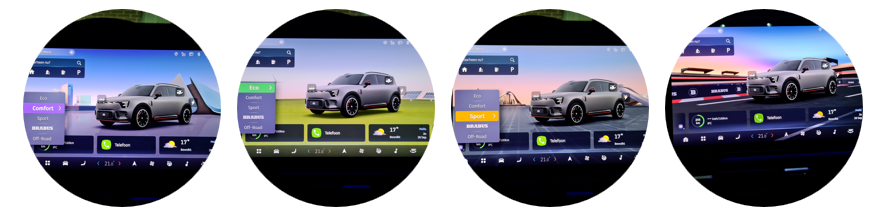
The smart #5 BRABUS offers five driving modes, each providing a different driving experience and vehicle tuning:
- Eco – Focused on maximum efficiency and energy saving. Power and response are limited to minimise consumption. The most commonly used mode during the test period.
- Comfort – A balanced mode for everyday use, offering a smooth ride and comfortable suspension.
- Sport – Enhances throttle response, power steering and possibly also damping for a more dynamic driving style.
- BRABUS – The most aggressive mode, in which all performance characteristics are enhanced. This includes maximum acceleration, sporty suspension tuning and a more powerful sound simulation (if available).
- Off-road – Optimises traction and stability for driving on unpaved terrain, such as sand, mud or snow.
In the BRABUS driving mode of the smart #5 BRABUS, a specially simulated engine sound (via the Sennheiser Signature Sound System) can be activated to enhance the driving experience and add an emotional dimension to electric driving. The sound is powerful, deep and sporty, inspired by classic combustion engines with a performance feel. You have the option to deactivate it. The choice is yours.
Brake energy recovery: low - medium - high
The smart #5 BRABUS offers three settings for brake energy recovery, which you can adjust via the infotainment system:
Low (Level 1): minimal regeneration, suitable for a smooth driving experience with little delay when releasing the accelerator pedal.
Medium (Level 2): average regeneration, offering a balance between energy recovery and driving comfort.
High (Level 3): maximum regeneration, ideal for efficient energy management and intensive braking without using the foot brake.
In addition, you can choose between two modes for stopping the car when you release the accelerator pedal:
Hold mode: the car comes to a standstill using the brakes.
Creep mode: the car moves forward slowly, similar to the behaviour of an automatic transmission in park mode.
These settings are available in the "Eco", "Comfort", "Sport" and "Brabus" driving modes.
You can add these to your favourites so you can play around with the different settings. Paddles on the steering wheel are still preferable.
Consumption
⚡ Fuel consumption and driving range smart #5 BRABUS
After 682 delightful test kilometres with the smart #5 BRABUS, we clocked an average consumption of 17.1 kWh/100 km. Thanks to the net battery capacity of 94 kWh, this translates into a theoretical driving range of 550 kilometres.
At an average outside temperature of 15°C, these are particularly impressive figures for a powerful, four-wheel-drive SUV.
Below you can read how the smart #5 BRABUS performed on different road types and in various driving modes.
Consumption by road type
Road type | Number of trips | Percentage (%) | Consumption (kWh/100 km) | Theoretical driving range(km) |
|---|---|---|---|---|
City | 1 | 7% | 12,8 | 734 km |
Non-urban | 6 | 40% | 16,6 | 566 km |
Motorway | 8 | 53% | 18,1 | 519 km |
Consumption per driving mode
Driving mode | Number of trips | Percentage (%) | Consumption (kWh/100 km) | Theoretical driving range (km) |
|---|---|---|---|---|
Eco | 11 | 73% | 16,6 | 566 km |
Comfort | 3 | 20% | 18,6 | 505 km |
BRABUS | 1 | 7% | 18,6 | 505 km |
Analysis
In total, we drove 15 trips, covering 682 kilometres. Most of this took place on the motorway (53%) and outside the city (40%), with only 7% of journeys in the city. This profile partly explains the average test consumption of 17.1 kWh/100 kilometres, as higher speeds have a noticeable impact on efficiency.
The Eco mode was used most frequently (73% of journeys) and delivered the lowest consumption (16.6 kWh/100 km), resulting in a driving range of 566 km. In Comfort and BRABUS mode, consumption rises to 18.6 kWh/100 km, which equates to a driving range of approximately 505 km.
In city traffic, consumption even dropped to 12.8 kWh/100 km, while on the motorway, air resistance caused an increase to 18.1 kWh/100 km.
*The specified driving range is a theoretical calculation based on the usable battery capacity. This is always a snapshot. All kinds of factors such as weather conditions, use of climate control, topography, traffic congestion and your own driving style can influence this.
Test track
As always, we are curious about the performance of the test vehicle on our regular test track. On 14 September 2025, the smart #5 BRABUS was subjected to a journey of 102.5 kilometres, completed entirely in Eco driving mode. The conditions were favourable: an average outside temperature of 18°C and the air conditioning was off, which has a positive effect on energy consumption.
During this journey, we recorded a combined consumption of 15.2 kWh per 100 kilometres. Based on the usable battery capacity of 94 kWh, this results in a theoretical electric range of 618 kilometres. This is a remarkable result for a performance-oriented SUV such as the BRABUS version, and demonstrates that the vehicle can perform exceptionally efficiently with an adapted driving style and use of Eco mode.
This test confirms that the smart #5 BRABUS is not only powerful, but can also be surprisingly economical in the right conditions. Its driving range of over 600 kilometres places it in the upper class of electric vehicles within its segment.
Bekijken we even de resultaten per onderdeel (wegtype)
Road type 1 – non-urban
- Distance: 40.5 kilometres
- Average speed: 43 kilometres per hour
- Consumption: 13.6 kWh/100 km
- SoC evolution: from 63% to 58%
- Estimated driving range based on battery capacity (net): 691 kilometres*
Analysis:
Highly efficient driving behaviour at low speeds and with high regeneration. Consumption is below average, resulting in a higher range. The SoC increases, which is exceptional and indicates a well-tuned Eco mode in combination with brake energy recovery.
Road type 2 – Motorway
- Distance: 41.4 km
- Average speed: 82 km/h
- Consumption: 19.2 kWh/100 km
- SoC evolution: from 58% to 50%
- Estimated driving range based on battery capacity (net): 490 kilometres
Analysis:
Higher consumption due to constant speed and air resistance. This is typical for motorway traffic, where regeneration occurs less frequently. The range decreases noticeably compared to Road type 1.
Road type 3 – city
- Distance: 20.6 km
- Average speed: 25 kilometres per hour
- Consumption: 12.8 kWh/100 km
- SoC evolution: from 50% to 47%
- Estimated driving range based on battery capacity (net): 734 kilometres*
Analysis:
Low consumption due to low speed and frequent regeneration moments.
Summary
- Eco mode delivers clear efficiency gains at low speeds and in urban traffic.
- Motorway driving significantly increases fuel consumption, which limits the driving range.
- Regeneration plays a major role in SoC evolution, especially at lower speeds.
- The smart #5 BRABUS proves surprisingly economical in Eco mode, despite its performance character.
Below is an overview of the evolution of the driving range (km) and the SoC (%).M
Road type | Driving range start (km) | Driving range finish (km) | Δ Range (km) | Start SoC (%) | Finish SoC (%) | Δ SoC (%) |
|---|---|---|---|---|---|---|
Non-urban | 340 | 312 | –28 | 63 | 58 | –5 |
Motorway | 312 | 269 | –43 | 58 | 50 | –8 |
City | 269 | 254 | –15 | 50 | 47 | –3 |
*The specified driving range is a theoretical calculation based on the usable battery capacity. This is always a snapshot. All kinds of factors such as weather conditions, use of climate control, topography, traffic congestion and your own driving style can influence this.
We strive to drive as efficiently as possible by making maximum use of cruise control (constant speed) and by anticipating traffic situations as much as possible. The speed on motorways is 110 km/h. Energy consumers (such as air conditioning) are switched off if weather conditions permit. In addition, we select the most efficient driving mode (Eco), if available.
Charging and driving range
General information
Internal board charger: 11 kW (Pro) and 22 kW (from Pro+)
The charging port is located at the rear left.
Version | Accu | Max. DC | Max. AC | Charging time 10–80% |
|---|---|---|---|---|
Pro | 74,4 kWh LFP | 150 kW | 11 kW | Approximately 35 minutes |
Pro+ | 94 kWh NMC | 400 kW | 22 kW | Approximately 18 minutes |
Premium | 94 kWh NMC | 400 kW | 22 kW | Approximately 18 minutes |
Pulse | 94 kWh NMC | 400 kW | 22 kW | Approximately 18 minutes |
Summit Edition | 94 kWh NMC | 400 kW | 22 kW | Approximately 18 minutes |
BRABUS | 94 kWh NMC | 400 kW | 22 kW | Approximately 18 minutes |
NMC stands for nickel-manganese-cobalt, LFP for lithium iron phosphate.
In total, we have completed two charging sessions with the smart #5 BRABUS: one DC and one AC. The DC charging session was particularly interesting to see the impact of the 800V architecture.
The DC charging session clearly illustrates the power of the smart #5 BRABUS's 800V architecture: an average charging speed of over 220 kW for 14 minutes.
The AC charging confirms that charging at home or at the office is convenient but slower — a realistic 20 kW on average, ideal for overnight charging.
Charging session | Type of charging | Driving range start (km) | Driving range finish (km) | SoC start (%) | SoC finish (%) | Charged driving range (km) | Loaded SoC (%) | Charged kWh | Duration (hh:mm) | Average charging speed (kW) | Speed (km range/min) |
|---|---|---|---|---|---|---|---|---|---|---|---|
1 | DC | 172 | 432 | 32 | 80 | 260 | 48 | 51,52 | 0:14 | 220,6 kW | 18,6 km/min |
2 | AC | 245 | 538 | 45 | 100 | 293 | 55 | 61,17 | 2:57 | 20,7 kW | 1,7 km/min |
Analyse:
DC charging:
In just 14 minutes, almost half of the battery capacity (48%) was recharged.
The average charging speed is around 221 kW, which is impressively close to the specified 400 kW peak.
This clearly illustrates the advantage of the 800V architecture for fast charging.
Kenmerk | Waarneming | Analyse / Conclusie |
|---|---|---|
SOC start | 32% → visible at the start of the session | The charging session starts in the ideal fast-charging range, which is beneficial for a high charging speed. |
SOC finish | 80% | Set at the start of loading |
Load capacity | ± 310–320 kW peak power (shown in graph) | The 800V architecture enables the smart #5 BRABUS to achieve peak power outputs in excess of 300 kW — exceptional in this segment.. |
Laadcurve | Fairly stable between 300 and 280 kW up to ±55%, then gradually decreasing | A typical charging profile for a well-optimised 800V system: long plateau zone with high charging speed. |
Duration | 14 minutes for 32 → 80% | Confirms an average charging speed of ±220 kW and a charging time of approximately 0.3 minutes per % SOC. |
Projected driving range | +260 kilometres charged in 14 minutes | Equivalent to ~18 kilometres of driving range per minute of charging – top score. |
AC charging:
Over a period of almost 3 hours, 55% of the battery was charged.
The average charging speed of approximately 21 kW is perfectly in line with the 22 kW AC charging capacity of the smart #5 BRABUS.
➡️ Conclusion:
The data confirms that the smart #5 BRABUS charges very efficiently via both DC and AC. With an average fast-charging speed of 221 kW, it ranks among the top in the EV segment, while the 22 kW AC charger offers flexibility for home charging or public AC charging stations.
Here is an overview of the information displayed during the charging process. Avatar Leo appears during charging with dynamic animations, making the process visually appealing. During fast charging (DC), LEO runs, and during normal charging (AC), LEO walks. The graph in the middle shows the charging curve (charging station).
The information shared during the charging process:
The Unreal Engine interface displays not only SoC, time and power, but also driving range and charging curve in real time – rarely seen in such visual detail in EVs.
At 80%, the message “Charging complete” appears automatically — the car stops the process itself, indicating an automated charging system with battery protection.

In summary
The images confirm that the smart #5 BRABUS is among the best in its class in terms of charging performance:
800V system with peaks up to >300 kW
32–80% in just 14 minutes
Intelligent, stable charging curve
Premium visualisation and user experience via the digital avatar Leo
Drive and comfort
Driving pleasure
The smart #5 BRABUS is not just any electric SUV — it is a statement on wheels. With its dual-motor four-wheel drive and an output of 637 hp (475 kW), it sprints from 0 to 100 km/h in 3.8 seconds, while Launch Mode and a top speed of 210 km/h ensure pure thrills. Select the BRABUS driving mode for insane speed. And you can choose whether you want this with or without sound.
BRABUS style
Inside, the BRABUS offers a luxurious and sporty atmosphere. The Sennheiser Signature Sound System with 20 speakers provides an immersive audio experience. The sports seats are heated and ventilated, and the interior is finished with microfibre upholstery, red stitching and illuminated BRABUS logos. The cockpit is high-tech with three screens, including a 13" passenger display.
Space – no problem
The smart #5 BRABUS offers five full-size seats with generous legroom, especially in the rear. Thanks to the panoramic halo roof and adjustable front seats, the interior feels light and open. The heated and ventilated sports seats ensure comfort in every season, while the heated rear seats are a rare luxury in this segment.
It also scores highly in terms of space. The rear cargo space is 630 litres, and with the rear seats folded down, this increases to 1530 litres — ideal for larger loads or holidays. For smaller items, there is also a 47-litre frunk at the front, handy for charging cables or a sports bag. The maximum towing capacity is 1600 kg, which also makes it suitable for a trailer or bike rack.
The exterior exudes power with 21" BRABUS Monoblock Z wheels, red brake callipers, and a sporty body kit. The panoramic roof and simulated engine sounds in BRABUS mode complete the picture.
Finally, it offers smart technology such as Vehicle-to-Load (V2L) up to 3.3 kW, Plug & Charge compatibility and navigation-controlled battery preheating for optimal charging speed.
Meet LEO – your digital co-pilot
No fox this time, but a lion that guides you with clever visual and spoken instructions, turning every journey into an interactive and intuitive experience.
High-tech cockpit
The dashboard is dominated by two 13-inch OLED screens, including a passenger display. Together with the Sennheiser Signature Sound System with 20 speakers and Dolby Atmos support, this offers an unrivalled digital and auditory experience.
Driver assistance systems (ADAS)
The Smart #5 BRABUS is equipped with a comprehensive package of Advanced Driver Assistance Systems (ADAS), designed to increase safety and driving comfort. Below is an overview of the most important systems: Smart Pilot Assist
Smart Pilot Assist
This advanced driver assistance system includes:
Adaptive cruise control with Stop & Go: Automatically maintains a safe distance from vehicles ahead and adjusts speed when traffic stops.
Lane Keeping Assist (LKA): Helps keep the vehicle within the lane.
Blind Spot Detection (BSD): Warns of vehicles in the blind spot.
Traffic sign recognition: Recognition of traffic signs and warnings.
Highway Assist with Lane Change Assist: Assists with motorway driving, including automatic overtaking of vehicles.
Traffic Jam Assist: Assists when driving in slow-moving traffic.
360° camera and parking sensors: Provide a full view around the vehicle for easy manoeuvring.
Automatic parking assist: Assists with automatic parking and manoeuvring out of parking spaces.
Adaptive high beam assistant (Premium and BRABUS only): Automatically adjusts the low beam based on traffic conditions.
These systems contribute to a semi-autonomous driving experience, especially on motorways and in heavy traffic. They work well without being overly intrusive. However, we would like to reiterate that these are driver assistance systems that are there to help you.
Simulation driving range (km), based on trip consumption (kWh/100 km), road type, trip length (km) and usable battery capacity (kWh)
The consumption analysis shows clear differences depending on the selected driving mode. In Eco mode, we recorded the lowest average energy consumption, resulting in a simulated driving range of 578 km. The Comfort mode is noticeably less efficient, with an average driving range of 505 km, comparable to the BRABUS mode, which achieves the same score.
In terms of road type, driving outside the city appears to be the most efficient: fuel consumption is consistently lower here than on the motorway. The increase in fuel consumption on motorways is logical, as higher air resistance plays a greater role at higher speeds — especially in an SUV with a less aerodynamic profile.
In short: those who adjust their driving style and remain in Eco mode clearly get the most out of the battery capacity — while a more dynamic driving style, typical of Comfort or BRABUS, has a noticeable impact on efficiency.
The graph below provides an overview of the possible driving range based on actual consumption. As always, these are theoretical approximations, as a large number of factors — such as temperature, traffic conditions and driving style — can influence consumption.
Comparison WLTP/test results Drivolution
Compare test results with WLTP figures
This graph shows the theoretical driving range of the Smart #5 BRABUS based on three consumption scenarios:
- WLTP standard: The official value of 17.4 kWh/100 km results in a driving range of 540 km. This is under standardised test conditions without external influences such as temperature, driving style or use of heating.
- DrivOlution test consumption: During the test week, an average consumption of 17.1 kWh/100 km was measured, resulting in a driving range of 550 km. This demonstrates that, under realistic conditions, the vehicle performs very close to the WLTP value.
- Test route: Exceptionally low consumption of 15.2 kWh/100 km was measured on a specific 102.5 km route. This translates into a theoretical driving range of 618 km, which is 14% higher than the WLTP value. This result highlights the car's potential for efficient driving and optimal conditions.
The smart #5 BRABUS combines powerful performance with surprisingly efficient energy consumption. DrivOlution's test results show that the vehicle can actually perform better than the official WLTP values in practice, especially under controlled driving conditions. This makes the model particularly interesting for users who want maximum range without compromising on driving pleasure.