Test review DrivOlution smart #3 BRABUS
Test report
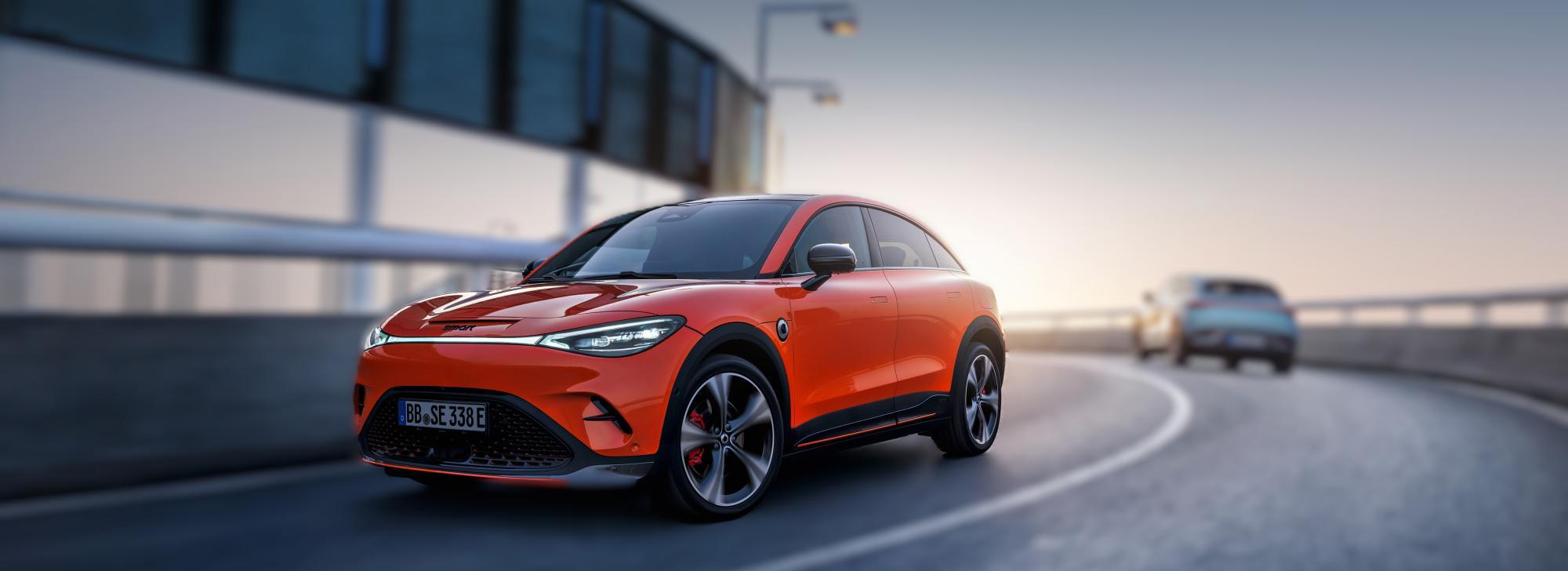
Clearly, smart models are getting bigger and bigger. The smart #3 is bigger than the smart #1, and for those who are interested, an even bigger version is coming: the smart #5. The smart brand is expanding and forming a real family. We are now a long way from the original concept of the famous two-seater.
At least the smart #3 has a more streamlined appearance than the smart #1, which should have a positive effect on consumption and range.
We had the chance to test drive the smart #3 for a week and were immediately introduced to the cream of the crop: the BRABUS edition.
General information
- SUV Coupé
- Mass in running order 1.985 kg
- Number of seats 5
- LxBxH (mm) 4.400 x 1.844 x 1.556
- Price test vehicle (taxis incl.) 49.995,- euro (based on configuration)
- Trunk volume 370L
- Frunk 15L
- Towing Capacity (1.600 kg Braked /750kg Unbraked)
- Warranty : 8 years/200,000 km on the battery
Driveline
- BEV (Battery Electric Vehicle)
- Lithium nickel cobalt manganese battery (NCM) with 66 kWh
- 66,0 kWh Battery capacity (62 kWh usable)
- Power 315 kW (428 hp) /115 front - 200 rear
- Torque 543 Nm / 200 front - 343 rear
- AWD
- Heat pump as standard
- EV-platform GEELY SEA2
Consumption/driving range (WLTP) (CoC)
- Combined consumption 17,6 kWh/100 km
- Combined driving range 415 km
- Driving range city 551 km
Charging information
- Internal on-board charger 22 kW
- Charging port rear left
- Charge Power AC 22 kW
- Charge Power DC 150 kW max.
- AC : 1 charge
- DC : 1 charge
Test track (106,3 km)
- Non-urban (45,2 km) 12,3 kWh/100 km
- Motorway (40,0 km) 16,4 kWh/100 km
- City (21,1 km) 12,0 kWh/100 km
- Combined 13,6 kWh/100 km
Consumption results (629 km)
- Non-urban 13,9 kWh/10 km
- Motorway 16,5 kWh/100km
- City 12,0 kWh/100 km
- Mix 16,3 kWh/100 km
- Combined 15,7 kWh/100 km
Test data
Test drivers
Johan Stevens
629 Testkilometers
Driveline
Drive
The smart #3 BRABUS uses the SAE2 (Sustainable Experience Architecture) platform. It is a modular electric vehicle platform developed by Geely Holding. The platform is planned to be used for the brands in Geely Holding's portfolio, along with the Smart joint venture with Daimler AG. The recently proposed Volvo EX30 and ZEEKR will also use this platform.
Versions
The smart #3 is available in various versions
- the smart #3 Pro: the entry-level car with the smallest battery of 49 kWh (47 kWh usable) LFP (lithium iron phosphate) battery. Good for 200 kW (272 hp) of power and 343 Nm of torque. The Pro is rear-wheel-drive. You will get 325 km (WLTP) far with this version.
- the smart #3 Pro+: from the Pro+, we move to the 66 kWh (62 kWh usable) NCM (Nickel - Cobalt - Manganese) battery. Power and torque are identical to the Pro. Also rear-wheel-drive and the electric driving range increases to 435 km (WLTP).
- the smart #3 Premium: its technical features are the same as previous versions. The Premium and the 25th Anniversary Edition have the greatest driving range of 455 km (WLTP).
- the smart #3 25th Anniversary Edtion: idem as the Premium
- the smart #3 BRABUS: the spiciest in the range courtesy of BRABUS. This version delivers 315 kW (428 hp) of power. Torque is 543 Nm. Moreover, it is all-wheel-drive.
- want more information on the different versions Discover the aerodynamic smart #3 | smart BE
Battery capacity - 47 kWh or 62 kWh (net)
Depending on the version chosen, you choose either the 47 kWh or the 62 kWh battery.
Driving modes - 4
The smart #3 BRABUS offers four driving modes: Eco, Comfort, Sport and BRABUS. The BRABUS mode offers particular fun with its power and virtual sound, allowing you to experience the BRABUS atmosphere in your car. Mainly, we used the Eco and Comfort modes.
Energy recuperation
The options here are limited. You can set the level of braking energy recovery yourself: medium or high. While trying both, I felt little difference. Moreover, you can opt for the 'S-Pedal', which introduces you to the principle of 'One-Pedal Driving'. With your power pedal, you can both accelerate and decelerate. Coasting or sailing (coasting) is not an option; as soon as you release the power pedal, you start slowing down. It takes some practice to master this technique.
Consumption
The results - overall In total, we added 629 km to the odometer of the smart #3 BRABUS, spread over 13 recorded trips. It is always interesting to measure and look at the results. The on-board computer shows an average consumption of 15.7 kWh/100 km. With a usable battery capacity of 62 kWh, this is enough for a driving range of 395 km, at an average outside temperature of 26 degrees.
The results - by road type
- The majority of the trips were made on motorways (8 out of 13, 62%): it yields an average consumption of 16.5 kWh/100 km. Good for a driving range of 376 km*.
- Outside the city, on secondary roads, we did 2 trips (15%). The smart #3 BRABUS recorded an average consumption of 13.9 kWh/100 km. If you can maintain this consumption then you can cover 446 km*.
- Only once did we venture into city traffic: here we stranded on a consumption of 12.0 kWh/100 km. In terms of driving range, this means 517 km*.
- Other than that, 2 trips that were a mix of motorway and out of town. The smart #3 BRABUS clocked in at 16.3 kWh/100 km. Good for a range of 380 km*.
The results - by driving mode
Following the DrivOlution DNA of efficient driving, Eco drive mode is our favourite.
- 7 out of 13 trips we chose Eco drive mode. It yielded a combined consumption of 15.0 kWh/100 km.
- Comfort driving mode (4 out of 13 trips) yielded a consumption of 16.4 kWh/100 km.
- We did not try Sport driving mode.
- We sampled the BRABUS driving mode 2 times. It yields a consumption of 16.6 kWh/100 km (BRABUS) respectively.
There is no doubt that the selected driving mode affects energy consumption. In addition, you handle the accelerator pedal differently in BRABUS mode than in Eco mode. The choice comes down to a trade-off between efficiency and sporty performance.
*The stated driving range is a theoretical calculation based on the usable battery capacity. This is always a snapshot. All kinds of factors such as weather conditions, use of air conditioning, topography, traffic density and your own driving style can influence this.
Test track
Consumption results - general
How did the smart #3 BRABUS perform on our test track? We covered a total of 106.3 km. This resulted in a combined consumption of 13.6 kWh per 100 km. With a usable battery capacity of 62 kWh, this would lead to an electric range of 456 km*. The average outside temperature was 30°C.
Consumption results - by road type
- On the 45.2 km trip out of town (secondary roads), the trip computer records consumption of 12.3 kWh/100 km. If you can maintain this consumption, this will get you 504 km* on a charge.
- during the 40 km motorway journey, consumption rises to 16.4 kWh/100 km. This results in an electric driving range of 378 km*.
- city drive of 20.5 km yields an average consumption of 12.0 kWh/100 km. This is good for an electric driving range of 517 km*.
Driving range evolution
We started with a range of 333 km. After the first part of the test track (out-of-town drive), there was still a range of 298 km left. The motorway drive reduced the range to 256 km. After the drive through town, 239 km remained. The total drive of 106.3 km consumed 94 km of the driving range.
To mention
During the off-road drive, we set the climate control to 'Eco'. For city driving, we chose 'S-Pedal', which stands for 'One-Pedal Driving'. Curious about the yield from braking energy recuperation: a total of 1 kWh regenerated.
*The stated driving range is a theoretical calculation based on the usable battery capacity. This is always a snapshot. All kinds of factors such as weather conditions, use of air conditioning, topography, traffic density and your own driving style can influence this. We strive to drive as efficiently as possible by making maximum use of cruise control (constant speed) and by anticipating traffic situations as much as possible. The speed on motorways is 110 km/h. Energy consumers (such as air conditioning) are switched off when weather conditions permit. In addition, we choose the most efficient driving mode (Eco), if available.
Charging and driving range
Charging information
The smart #3 BRABUS features an internal on-board charger of 22 kW. The maximum fast-charging capacity is 150 kW. The charging port is located at the left rear. smart #3 recommends charging up to 90% in daily mode and up to 100% for remote mode. This is to maintain optimum battery condition.
Charging sessions
We hooked up the smart #3 BRABUS to the charging station twice, once AC and once DC. Further information regarding the charging sessions can be found in the graph below.
Charging curve - constant
The charging curve course is relatively constant when fast charging.
Information charging process - for the driver
As a driver, you are sufficiently informed about the evolution of the charging process.
Obviously, charging time depends on the SoC (State of Charge) at the start of charging, the outdoor temperature and the temperature of the battery.
Drive and comfort
Driving - pay attention when it tingles in your right foot
Driving behaviour depends on the setting selected. The smart #3 BRABUS offers a choice between a soft or a dynamic/sporty driving style; both are excellent. Roadholding is excellent. During the test period, we focused mainly on an efficient driving style, with sportiness being less of a priority. Given the available power of the smart #3 BRABUS, this is not always easy. Sometimes it is hard not to press harder on the power pedal.
9.2-inch full-HD digital instrument panel
It is a hot topic and also visible in the smart #3: the traditional "dashboard" designed around the driver gives way to a more compact instrument panel. This panel provides the driver with all essential information, such as the selected driving mode, driving range and battery charge status. This is becoming increasingly common. The instrument panel in the smart #3 is beautifully integrated and offers a clear display.
12.8" full-HD central touchscreen with 1920 x 1080 pixels
For the rest of the functions such as climate control, radio, navigation, you have to rely on the central touchscreen. This too takes some getting used to to find everything back. Adjusting the mirrors is also done via the touchscreen.
10-inch head-up display (HUD)
The HUD is clearly readable. It increases safety as you have all important information in your field of vision.
BRABUS - design elements
When you opt for the BRABUS edition, your expectations are understandably higher, not only in terms of performance but also in terms of design. The interior features include BRABUS sports seats, BRABUS headrests, the BRABUS name on the steering wheel, BRABUS interior colours and BRABUS pedals.
Space inside - fine
The rear seat is horizontally adjustable in a 60/40 split, pass-through hatch for long pieces of luggage (such as skis) in the middle of the rear seat as standard.
Finish - no comments
The finishing inside is of high quality.
ADAS
Safety and ADAS
The smart #3 BRABUS has no shortage of driving assistance systems. Although it is difficult to list them all, the essential (mandatory) systems are present. The Smart Pilot Assist includes: adaptive cruise control with Stop & Go function, Lane Keeping Assist, blind spot detection, traffic sign recognition, highway assistant with lane keeping assist and traffic jam assistant, parking assist sensors, a 360-degree camera, and automatic parking assist (not available on Pro & Pro+), as well as adaptive high beam (also not available on Pro & Pro+).
Operation
It is evident that current driver assistance systems function adequately. Are they flawless? No. Driver vigilance is still essential. Moreover, some systems can sometimes be perceived as annoying. It takes getting used to dealing with them.
Driving range simulation (km) based on trip consumption (kWh/100 km) and trip lenght (km)
Traditionally, we simulate range based on consumption per trip and available net battery capacity. Both consumption and range depend on many factors. The results given are therefore always time-dependent.
Comparison WLTP/test results Drivolution
Comparing test results on consumption and driving range with the WLTP figures, we score better on consumption but less on driving range.
And there is more ...
Still want some more BRABUS spirit? Take a look at https://www.brabus.com/en-int/coops/brabus-x-smart/smart3.html