Test review DrivOlution Renault Scenic E-Tech 100% Electric Iconic
Test report
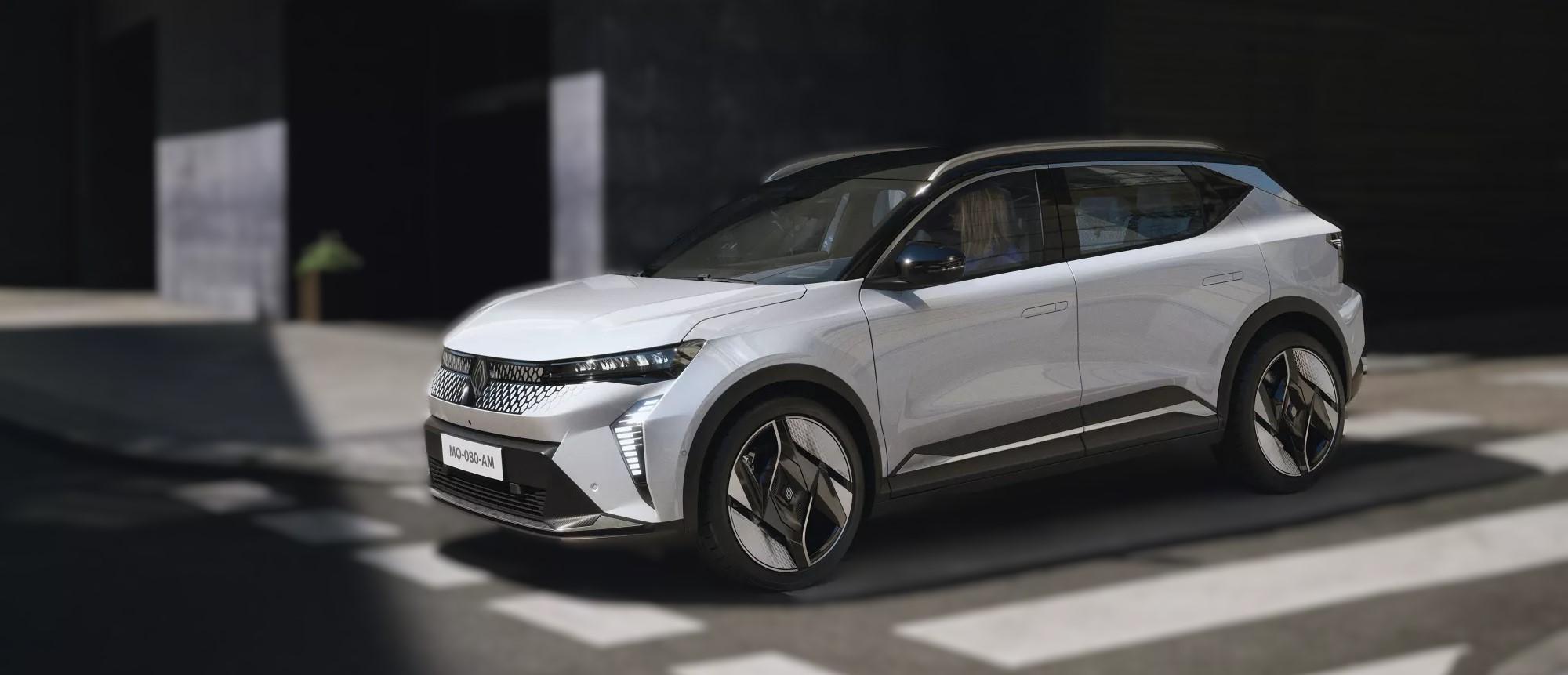
Renault is no stranger when it comes to electric vehicles. Just think of the Zoe. In 2022, we already got to test drive the Megane E-Tech 100% Electric. Now the Scenic is also added to the picture. Born in 1996 and after 27 years, the Scenic also enters the electric market segment. The new Scenic (Safety Concept Embodied in a New Innovative Car) is an SUV mainly aimed at families and those in need of freedom and safety. It also fits into the Renaulution strategy.
Our test car is the Scenic E-Tech 100% Electric Long Range Iconic. Let's meet the 2024 'Car of the Year'. You don't get this 'international award' overnight. You have to work for it. Let's see what he has to offer.
General information
- SUV
- Number of seats 5
- Mass in running order 1.917 kg
- LxWxH (mm) 4.470 x 1.864 x 1.565
- Price test vehicle (taxis incl.) 55.290,- euro
- Cargo volume 545 L / 1.670 L (max)
- Cargo volume frunk 0 L
- Tow Hitch Possible yes (1.100 kg towing braked/750 kg towing onbraked)
- Warranty : 8 years/160,000 km on the battery
Driveline
- BEV (Battery Electric Vehicle)
- Battery type Lithium-ion (NCM)
- 92,0 kWh Battery capacity (87 kWh usable)
- Power 160 kW (218 hp)
- Torque 300 Nm
- FWD (front-wheel drive)
- Heat pump as standard
- EV specific platform - AmpR Medium (CMF-EV)
- V2L function no
Consumption/driving range (WLTP) (CoC)
- Combined consumption 17,4 kWh/100 km
- Combined driving range 603 km
- Driving range city 784 km
Charging information
- Internal onboard charger 22 kW (11 kW standard)
- Charging port location - right side front
- Charge Power AC 22 kW (11 kW standard)
- Charge Power DC 150 kW max.
- AC : 1 charge
- DC : 2 charges
Test track (101 km)
- Non-urban (41,5 km) 12,6 kWh/100 km
- Motorway (39,7 km) 15,7 kWh/100 km
- City (19,8 km) 11,7 kWh/100 km
- Combined 13,3 kWh/100 km
Test results (690 km)
- Non-urban 19,8 kWh/10 km
- Motorway 17,8 kWh/100km
- City 11,7 kWh/100 km
- Mix 18,8 kWh/100 km
- Combined 18,1 kWh/100 km
Test data
Test drivers
Johan Stevens
690 Testkilometers
Driveline
Electric platform
The modular AmpR medium (known as the CMF-EV platform) serves the Megane E-Tech 100% Electric as well as the Scenic E-Tech 100% Electric. It offers optimised weight and a very low centre of gravity which guarantees a dynamic and responsive driving experience.
Battery - 2 packs
With the new Scenic E-Tech Electric, you have a choice of two battery capacities:
- the Scenic EV60 Comfort Range has a 60 kWh battery pack and a power output of 125 kW (170 hp). Torque is 280 Nm. The Comfort Range offers you a driving range of 430 km (WLTP).
- The Scenic EV87 Long Range has a larger battery capacity of 87 kWh. Power rises to 160 kW (220 hp) and torque is 300 Nm. This version will get you 625 km (WLTP).
MULTI-SENSE: perfectly tailored to your needs
There are four modes - Comfort, Sport, Eco and Perso. Each mode offers a different ambience by combining interior lighting, driver seat comfort, interior temperature and screen colour with driving sensations (steering resistance, driveline calibration and pedal response) in different ways. As always, our focus is mainly on Eco driving mode.
Four levels of regenerative braking and paddles - top!
The Scenic E-Tech Electric features four levels of regenerative braking.
- Level 0 is no regeneration. Perfect level to get the car coasting (rolling).
- At level 1 in Drive mode, you have a slight deceleration as soon as you take your foot off the power pedal. The car's kinetic energy is converted into electrical energy, which is stored in the battery. The electric motor also acts as a generator when the braking system is used to harvest energy.
- At level 1, the deceleration is stronger.
- At level 3, you have maximum regeneration. Ideal for city driving.
You can perfectly control the degree of regeneration yourself using the paddles behind the steering wheel. The car's kinetic energy is converted into electrical energy, which is stored in the battery. The electric motor also acts as a generator when the braking system is used to harvest energy.
Consumption
De resultaten - algemeen
We completed 690 test kilometres aboard the Renault Scenic E-Tech 100% Electric. It resulted in a combined consumption of 18.1 kWh/100 km, spread over 19 recorded journeys. Based on the usable battery capacity of 87 kWh, this corresponds to an electric driving range of 481 km*. The average outdoor temperature was 9°C.
The results - by road type
- Most of the trips were done on motorways (12 of 19 trips): it yielded an average consumption of 17.8 kWh/100 km, good for a driving range of 489 km*.
- Outside the city, on secondary roads, we did 5 trips. This results in a combined consumption of 19.8 kWh/100 km. If you can maintain this consumption, you can cover 439 km*.
- Only once did we venture into city traffic: here we stranded on a consumption of 11.7 kWh/100 km. In terms of driving range, this means 744 km*.
- Furthermore, we have a mix of motorway and secondary roads. It results in a consumption of 18.8 kWh/100 km.
- The lowest realised consumption is 11.7 kWh/100 km and the highest is 33.7 kWh/100 km.
The results - by driving mode
Eco driving mode remains the predominant driving mode.
- In 12 out of 19 trips, we chose the Eco. It yielded a combined consumption of 17.8 kWh/100 km.
- Comfort driving mode (3 out of 19 trips) yielded consumption of 17.4 kWh/100 km.
- in Personal driving mode have completed 4 trips, yielding consumption of 19.5 kWh/100 km respectively .
*The stated driving range is a theoretical calculation based on the usable battery capacity. This is always a snapshot. All kinds of factors such as weather conditions, use of air conditioning, topography, traffic density and your own driving style can influence it.
Test track
Consumption - general
Let's take a look at how the Renault Scenic E-Tech 100 % Electric performed on our 101 km test course. The on-board computer closes in on a combined consumption of 13.3 kWh/100 km on the three parts. This equates to a driving range of 654 km* if you could keep this consumption constant. We add that we had the weather gods on our side with an average outside temperature of 17°C. Clearly noticeable in the results achieved.
Consumption per road type
- the 41.5 km suburban section (secondary roads) yields consumption of 12.6 kWh/100 km, resulting in a driving range of 690 km*.
- on the motorway section of 39.7 km, we arrive at a consumption of 15.7 kWh/100 km which is good for a driving range of 554 km*.
- the city journey of 19.8 km is good for a consumption of 11.7 kWh/100 km, which gets you 744 km* on a charge.
Driving range evolution
We start with a driving range of 366 km and an SoC of 62%.
- After the non-urban drive, the driving range drops to 344 km (-22 km) and the SoC is 55% (-7%).
- The motorway journey drops the driving range further to 292 km (-30 km). The SoC is 48% (-7%).
- After the city drive, we are left with 278 km of driving range (-14 km) with an SoC of 45% (-3%).
88 km cost the total trip of 101 km in driving range. The SoC dropped by 17%. Not unkind figures I would say.
*The stated driving range is a theoretical calculation based on the usable battery capacity. This is always a snapshot. All kinds of factors such as weather conditions, use of air conditioning, topography, traffic density and your own driving style can influence this.
We strive to drive as efficiently as possible by making maximum use of cruise control (constant speed) and by anticipating traffic situations as much as possible. The speed on motorways is 110 km/h. Energy consumers (such as air conditioning) are switched off when weather conditions permit. In addition, we choose the most efficient driving mode (Eco), if available.
Recharging and driving range
Internal on-board charger
The Renault Scenic E-Tech 100% Electric has an internal on-board charger of 22 kW. The maximum DC charging power is up to 150 kW.
More energy density
The Scenic E-Tech 100% Electric's battery has 6% more energy density than the Megane E-Tech electric's battery, thanks to a new NMC (nickel, manganese, cobalt) battery chemistry from LG. Calories from the battery and powertrain are then harvested when the car slows down or brakes, and then used to heat the passenger compartment via a heat pump, which is fitted as standard in all new Scenic E-Tech electric versions.
Recharging
We visited a charging station a total of 4 times.
- Charging sessions AC: 1 (from SoC 32% to SoC 73%). Intended to charge to 100% though some problems with the charging station but charged to 73%.
- Charging sessions DC: 2
Information charging process - for the driver
As a driver, you are sufficiently informed about the evolution of the charging process. The following information is displayed on the screen:
- Estimated charging time (hh:mm)
- Load capacity (km)
- Estimated driving range (km)
- SoC (%) current
- SoC (%) load percentage set
Pre-conditioning - yes
Always nice to leave with a warmed-up interior. And it avoids having to 'scratch' in winter. Moreover, this has a positive effect on consumption and driving range. For example, you can set your departure time and weekly schedule together for air conditioning and charging. Other, more precise settings (air conditioning temperature, areas to be pre-heated, specific times, etc.).
Conditioning the battery - yes
An important factor for efficient charging is preconditioning the battery. The optimal battery temperature is 25°C. The system uses Google Maps to automatically start preconditioning the battery when you get near the charging points you have selected in the app. So the battery will have the ideal temperature on arrival, allowing you to charge it faster and/or more. You can use the OpenR Link system as well as the My Renault app for more simplicity and efficiency.
Load percentage adjustable - yes
You can set the charging percentage (SoC) via the on-board computer or via the app. No 'recommended charge percentage' is displayed.
Drive and comfort
Interior
The interior of the Scenic E-Tech 100% Electric closely matches that of the Megane E-Tech 100% Electric. It feels comfortable. The whole thing exudes solidity.
Dashboard - screens
Today, we no longer speak of a dashboard but of a sum of screens. It takes some getting used to. A plus with the Scenic is that the 12.7-inch driver's display is not the size of a smarphone. It is uncluttered and contains key information. The vertical touchscreen measures 12 inches. These two screens are part of the OpenR infotainment system. Many functions can be controlled from the central screen. In addition, physical buttons can still be found under the screen, on the steering wheel and on the left side of the dashboard.
Controls - practical
The controls for cruise control and other functions are fine. The radio controls are, traditionally, somewhat awkwardly tucked away behind the steering wheel. Selecting driving modes is easy via the Multi-Sense button.
Space - enough for the family
It is not an MPV but the Scenic E-Tech 100% offers more than enough space for the family.
Trunk - from 545 L to 1670 L
Folding down the rear seats brings you up to a luggage space of 1670 L. As with the Megane E-Tech 100% Electric, the lifting threshold of the boot is quite high, especially if you need to load some heavier items. Something we don't often find among Europeans is a frunk, or front luggage compartment. Too bad.
Advanced Driving Assist Systems (ADAS)
Driving assistance systems
The Scenic E-Tech 100% Electric features a large number (36) of advanced driving assistance systems and more than 60 safety features. A few we would like to make special mention of.
Safety Coach - evaluates your driving behaviour
To keep you on track as a driver and reduce the risk of accidents, the new Renault Scenic E-Tech Electric is equipped with a tool called Safety Coach. This tool informs you about your driving behaviour and habits, which are objectively assessed, and provides tailored advice on driving style and ADAS use. The advice is based on feedback from the Safety Score analysis tool, which uses data from the vehicle's sensors and front camera to assess three key driving factors: acceleration/distance (safe distance from the car in front), compliance with the legal speed limit and trajectory behaviour (turn signals and lateral speed). The system allows you to play a more active role in maintaining safe driving behaviour. It is also of particular interest to young drivers as it helps them develop good driving habits.
Active Driver Assist
The next-generation highway and traffic assistant is equivalent to Level 2 automation on motorways and motorways. It combines context-aware adaptive cruise control, Stop & Go, lane centring and geolocation data on a specially designed map to adapt predictively to the road. At low speeds (e.g. in traffic jams), the lane centring system can be temporarily adjusted by the driver to keep the vehicle on one side of the road and allow priority vehicles to overtake on the other side.
Driving range simulation (km) based on trip consumption (kWh/100 km) and trip lengt (km)
Based on trip consumption and usable battery capacity, we can simulate the (theoretical) driving range. Although this is always a snapshot, it gives a clear picture of how far you could theoretically drive at a given consumption. Of course, various factors can influence these results. The outside temperature , the trip profile and not forgetting your driving style remain important factors. The 3km trip is not really representative.
Comparison WLTP/test results Drivolution
Comparing the consumption results achieved with the manufacturer's WLTP figures, we come pretty close to the WLTP figures, taking into account the test period. Taking into account an average outdoor temperature of 9°C, we can be quite satisfied.