Test review DrivOlution Polestar 4 Long Range Dual Motor with Performance package
Test report
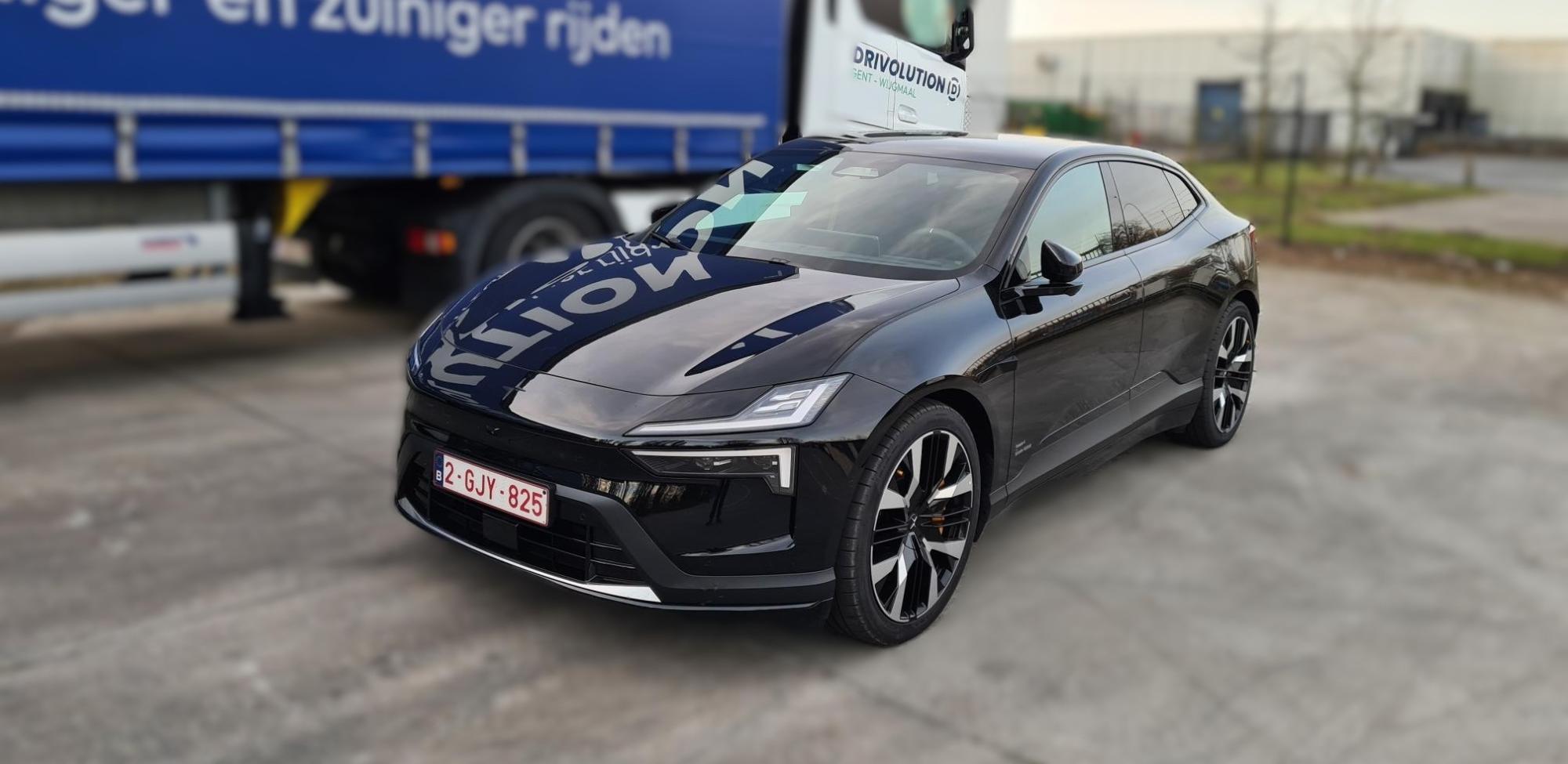
Polestar, meanwhile, needs no introduction. Polestar began as a performance division of Volvo (similar to AMG at Mercedes), but became an independent brand in 2017, co-owned by Volvo Cars and its parent company Geely (from China). Polestar exclusively develops electric cars, with the exception of the Polestar 1. Their mission is to create a sustainable future with electric mobility, high-performance technology and minimalist Scandinavian design.
We had to wait a while for the expansion of the Polestar family, but it is finally here: we can welcome the Polestar 3, a full-size SUV, and the Polestar 4, a sleek SUV Coupé.
The Polestar 4 in particular stands out with its striking and contemporary design. The biggest eye-catcher? The complete lack of a rear window.
We got the chance to take the Polestar 4 Long Range Dual Motor with the Performance package out for a week. As always, we were curious about its performance in terms of fuel consumption and driving range, without losing sight of comfort.
General information
- SUV Coupé
- Number of seats 5
- Mass in running order 2.430 kg
- LxWxH (mm) 4.840 x 2.008 x 1.534
- Price test vehicle (VATi) 91,000, - euro
- Tow Hitch possible yes (unbraked 750 kg - braked 2.000 kg)
- Cargo volume 526 L/1.536 L (max)
- Cargo volume frunk 15 L
- Battery warranty : first 8 years or 160 000 km, whichever occurs first.
- Vehicle warranty : 2 years
Driveline
- BEV (Battery Electric Vehicle)
- Battery type Lithium-ion (NMC)
- 100 kWh Battery capacity (94 kWh usable)
- Power 400 kW (544 hp)
- Torque 686 Nm
- All-wheel drive (AWD)
- Architecture 400 V
- EV-specific platform - GEELY SAE1
- Heat pump standard
- V2L : no
Consumption/driving range (WLTP) (CoC)
- Combined consumption 21,7 kWh/100 km
- Combined driving range 500 km
- Driving range city 618 km
Recharging information
- Internal onboard charger 22 kW
- Charging port rear left
- Charge Power AC 22 kW
- Charge Power DC 200 kW max.
- AC : 2 charges
- DC : 3 charges
Test track (108 km)
- Non-urban (40,7 km) 15,1 kWh/100 km
- Motorway (47,3 km) 18,4 kWh/100 km
- City (20,0 km) 13,7 kWh/100 km
- Combined 15,7 kWh/100 km
Test results (1.011 km)
- Non-urban 20,9 kWh/100 km
- Motorway 19,5 kWh/100km
- Urban 13,7 kWh/100 km
- Mix 20,3 kWh/100 km
- Combined 19,6 kWh/100 km
Test data
Test drivers
Johan Stevens
1011 Testkilometers
Drivetrain
Platform
The Polestar 4 offers a strong combination of technology and performance, built on the GEELY SEA1 platform, which is also shared with other vehicles such as the Zeekr 001 and the Volvo EM90. This platform provides a solid foundation for Polestar's electric SUV coupe.
Drive:
The Polestar 4 comes in two variants:
- Long Range Single Motor (rear-wheel drive):
- Power: 200 kW (272 hp)
- Torque: 343 Nm
- WLTP driving range: around 620 km
- Focus on efficiency.
- Long Range Dual Motor (all-wheel drive):
- Power: 400 kW (544 hp)
- Torque: 686 Nm
- WLTP driving range: around 590 km
- The more powerful version with an additional engine for improved performance and grip, while still keeping the range relatively high.
- This version has a switchable front engine, allowing you to increase the car's range when performance is not a priority.
More information on the versions of the Polestar can be found here Polestar 4 – De elektrische SUV-coupé | Polestar België
Battery capacity:
The Polestar 4 uses a single battery option of 100 kWh, of which 94 kWh is usable, with effective range depending on engine configuration.
Driving modes:
The Polestar 4's driving modes are limited to:
- Range Mode: focus on energy efficiency and maximum driving range. Our favourite driving mode.
- Performance Mode: Focuses on better performance and faster response.
Braking energy recuperation:
The Polestar 4 offers the option to enable One Pedal Driving (OPD), which largely eliminates the need for the brake pedal and adjusts driving behaviour according to the degree of recuperation. There are several settings:
- Off: no regenerative braking.
- Low: Lower degree of regeneration.
- Standard: Standard regeneration setting.
This makes it best for drivers to make their choice in advance. Via a hotkey on the screen, you can still "play" with regeneration a bit by switching it on and off yourself.
Consumption
Overall consumption:
After 1,011 test kilometres, the Polestar 4's combined consumption was found to be 19.6 kWh/100 km. This theoretically translates to a driving range of around 472 km* on a full 94 kWh battery, depending on driving behaviour and conditions. Outside temperatures averaged 15°C, which as expected affects both consumption and range.
Consumption by road type:
- Motorway: most trips (11 out of 19) were driven on the motorway, resulting in a consumption of 19.5 kWh/100 km which would give a theoretical driving range of 465 km*. This was driven over a total of 760.7 km on the motorway.
- Secondary roads: 4 trips were made on secondary roads, accounting for 75.3 km, with a slightly higher consumption of 20.9 kWh/100 km, which would result in a theoretical driving range of 450 km* if consumption was consistent.
- City traffic: the drive through city traffic gave the lowest consumption of 13.7 kWh/100 km, which would result in a driving range of 686 km*. However, this only concerns a short drive of 20.0 km, so results may vary depending on city traffic.
- Mix of motorway and secondary roads: 4 trips and total of 153.6 km resulted in a consumption of 20.3 kWh/100 km. Enough to cover 463 km*.
Consumption variation:
The lowest consumption achieved was 13.7 kWh/100 km(in city driving), while the highest consumption was 30.9 kWh/100 km (probably during more intensive driving conditions).
Consumption by driving mode:
All trips were driven in Range mode, which emphasises energy efficiency and maximum driving range.
In summary, this test shows that the Polestar 4 has fairly stable consumption in a wide range of driving conditions, with the greatest variation at higher speeds (such as on the motorway) or depending on the terrain (city versus secondary roads).
*The stated driving range is a theoretical calculation based on the usable battery capacity. This is always a snapshot. All kinds of factors such as weather conditions, use of air conditioning, topography, traffic density and your own driving style can influence it.
Test track
Consumption - general
On the test track, the Polestar 4 achieved a combined consumption of 15.7 kWh/100 km over a total of 108 km. This is a reasonably efficient consumption, especially considering the average outside temperature of 20°C.
Consumption and driving range:
With this consumption, the Polestar 4 could theoretically achieve a driving range of 599 km* on a full charge, taking into account the usable battery capacity of 94 kWh. Without along a handsome result, courtesy of the weather.
Additional note:
The motorway drive was a bit longer than usual due to roadworks, which may have affected the final consumption, but despite this, the Polestar 4 seems to offer a reasonably good range in these conditions.
Consumption by road type
- the 40.7 km out-of-town (secondary roads) section yields consumption of 15.1 kWh/100 km, resulting in a driving range of 623 km*.
- on the motorway section of 47.3 km, we arrive at a consumption of 18.4 kWh/100 km which is good for a driving range of 511 km*.
- the city journey of 20.6 km is good for a consumption of 13.7 kWh/100 km, which gets you 686 km* on a charge.
Driving range evolution
The driving range and State of Charge (SoC) of the battery declined well during the drive, providing insight into energy consumption in different driving conditions. Here is a summary of the data:
- Start:
-
- Starting driving range: 420 km
- Starting SoC: 80%
- After non-urban drive:
- Driving range: 386 km
- SoC: 74%
- Loss: 34 km driving range, 6% SoC
- After motorway drive:
- Driving range: 337 km
- SoC: 65%
- Loss: 49 km driving range, 9% SoC
- After city driving:
- Driving range: 321 km
- SoC: 62%
- Loss: 16 km driving range, 3% SoC
- Total trip:
- Total loss in driving range: 99 km
- Total loss in SoC: 18%
-
Conclusion:
The total trip cost 99 km of driving range, and the SoC dropped by 18%. This indicates that consumption was fairly consistent across the different trips, but with a clearly greater loss of driving range on the motorway, as is often the case due to higher speeds. The city drive was the least energy-intensive, with a small loss of driving range and SoC.
*The quoted driving range is a theoretical calculation based on usable battery capacity. This is always a snapshot. All kinds of factors such as weather conditions, use of air conditioning, topography, traffic density and your own driving style can influence this.
We strive to drive as efficiently as possible by making maximum use of cruise control (constant speed) and by anticipating traffic situations as much as possible. The speed on motorways is 110 km/h. Energy consumers (such as air conditioning) are switched off when weather conditions permit. In addition, we choose the most efficient driving mode (Eco), if available.
Recharging and driving range
Charging systems of the Polestar 4
- Internal on-board charger: The Polestar 4 is equipped with an internal on-board charger offering 11 kW for AC (alternating current) charging. You can expand this to 22 kW with the Plus package.
- DC fast charging: The maximum charging capacity via DC charging is 200 kW. This enables fast battery charging at a compatible fast charger.
Charging port
- The charging port is located at the left rear of the car and is opened via the central touchscreen instead of a physical button.
Recharging sessions
- Number of recharging sessions: we hooked up the Polestar to the charging station 4 5 times, depending on the number of kilometres travelled.
- Recharging sessions AC: 2
- Recharging sessions DC: 3
Information about the charging process
As a driver, you are well informed about the progress of the charging process via the central screen in the car. The following data is visible:
- Estimated charging time (hours:minutes)
- Charging power (kW)
- Driving range while charging (km)
- Current charge percentage (SoC, State of Charge)
- Set charge percentage (SoC)
Charge percentage adjustable
Polestar recommends limiting the charge percentage to 90% to improve battery health. This is a common practice for electric vehicles to extend battery life.
Route planning based on battery status
The Polestar 4 features an integrated version of Google Maps that works closely with the vehicle electronics to monitor battery status. Based on the current battery level, the app automatically calculates the most efficient route and suggests suitable charging stations along the way.
Energy-saving heat pump
Residual heat need not be lost heat. Using thermal energy from the electric motors, battery and ambient air, the heat pump can heat the interior and helps get more mileage out of a charge by reducing the need for air conditioning.
Drive and comfort
Style, space and no rear window
The Polestar 4 is no typical SUV coupé, and you notice that as soon as you get in. This all-electric car manages to combine futuristic design, smart technology and everyday comfort in a package that feels both functional and refined. The Polestar 4's eye-catcher is the lack of the rear window. In doing so, it adopts a key design element from the Polestar Precept. This makes room for an extra-long panoramic roof and considerable headroom, giving passengers a spacious feeling.
2-in-1: rear-view mirror and display
Instead of a rear-view mirror, the Polestar 4 has a high-resolution rear-view mirror/display. This also functions as a regular mirror, to alternate between the live images and the view of the rear passengers. Not surprisingly, this requires some adjustment.
Space - boot
The Polestar 4 packs a roomy trunk. With the seats upright, you get 526 litres of cargo volume. Folding the seats down gives you 1,536 litres of cargo volume, including the space under the loading floor. The loading sill is low and the opening wide, making loading and unloading particularly easy. Ideal if you often travel with family or lots of luggage. Oh yes, let's not forget the frunk or front luggage compartment with a 15-litre load volume, ideal for storing your charging cables.
And in the back?
Don't forget passengers in the back. There is plenty of space and comfort in the back seat, with plenty of legroom for adult passengers, and between the front seats, there is a second touchscreen that can be used to control the emperatuur, seat heating and media. Not only is it practical, it is beautifully integrated into the design. Everything from the material to the interface feels high quality.
Interior: minimalist yet pleasant
Inside, the Polestar 4 exudes an air of tranquillity. The interior is sleek and modern, with a minimalist aesthetic that does not, however, come across as cold. Minimalist is a trend we see more and more of today. The front seats offer excellent support, even on longer journeys.
Infotainment
You have a 10.2-inch driver display (with 1920 x 532 px resolution) and a 15.4-inch centre display (1920 x 1200 px resolution). The 10.2-inch driver display shows only important information, such as speed, navigation directions and battery status. It has three different display modes, each orderly arranged to avoid distractions. And by counter tradition, most of the functions serve via the central touchscreen: controlling the mirrors, climate control, radio and you name it.
Google - Google Assistant - 5G internet: this shouldn't be missing right?
With integrated Google¹ apps and services, the Polestar 4 immediately becomes part of the driver's digital ecosystem. Google Assistant and Google Maps can communicate with the car to make life on the road even easier. Thanks to Google¹ Assistant's voice recognition, the driver can control music, climate settings and other functions while you keep your eyes on the road and your hands on the wheel. Just say "Hey Google" to get started. Secure 5G internet is available as standard and offers web access, real-time traffic updates, high-quality audio and video streaming and dedicated in-car versions of mobile apps. The first three years of data usage are included in the purchase price of the car.
Driver assistance systems (ADAS)
Sensors and cameras
The Polestar 4 is equipped with an advanced driver assistance system (ADAS) that uses a combination of sensors and cameras to enhance safety and driving experience. The system hulls one mid-range radar, 11 external cameras and 12 ultrasonic sensors to monitor the vehicle's surroundings. This enables real-time evaluation of potential safety issues and provides timely interventions when needed.
The purpose of driver assistance systems is to improve both safety and driving comfort. Indeed, some of these systems are mandatory. Some of these include:
These (driving aid) systems contribute to a safe and comfortable driving experience with the Polestar 4. Here, we would like to emphasise once again that they are assistance systems. The final responsibility always lies with the driver.
- Adaptive Cruise Control (ACC): automatically adjusts speed to maintain a safe following distance from the vehicle in front.
- Pilot Assist: supports you as a driver at speeds up to 130 km/h by correcting the steering and maintaining the lane. The intervention is quite brusque which is not always pleasant.
- Lane Keeping Aid: helps prevent the car from changing lanes unintentionally by making minor steering corrections.
- Lane Change Assist: enables automatic lane change by switching on the indicator, provided it is safe to do so.
- Intelligent Speed Assist (ISA) : Recognises speed signs and warns if the speed limit is exceeded. Yet be careful because during journeys it was found that ISA was often wrong.
- Cross Traffic Alert (CTA) with brake assist: Warns of approaching traffic when reversing and brakes if necessary to avoid a collision.
- Exit assistance: warns occupants of approaching vehicles, cyclists or pedestrians when opening the doors.
- Oncoming Lane Mitigation: Warns and corrects for unintentional crossing of lane markings towards oncoming traffic.
- Front and Rear Collision Avoidance: Detects potential front and rear collisions and can automatically brake to reduce impact.
- Driver Monitoring System: is placed in front of the steering wheel and it tracks your eye and head movements to detect signs of distraction or fatigue. If such signs are detected, the system immediately issues audible and visible warnings. Unfortunately, it is set too sensitively.
Driving range simulation (km) based on trip consumption (kWh/100 km) and trip length (km)
Based on trip consumption and usable battery capacity, we can simulate the (theoretical) driving range. Although this is always a snapshot, it gives a clear picture of how far you could theoretically drive at a given consumption. Of course, various factors can influence these results.
Comparison WLTP/test results Drivolution
If we compare the consumption results achieved with the WLTP figures, we score favourably. This both in terms of consumption and driving range. If we compare the tested consumption of the Polestar 4 with the WLTP figures, we see that the real-world results are surprisingly favourable, which is quite remarkable.