Test review DrivOlution MINI Aceman SE
Test report
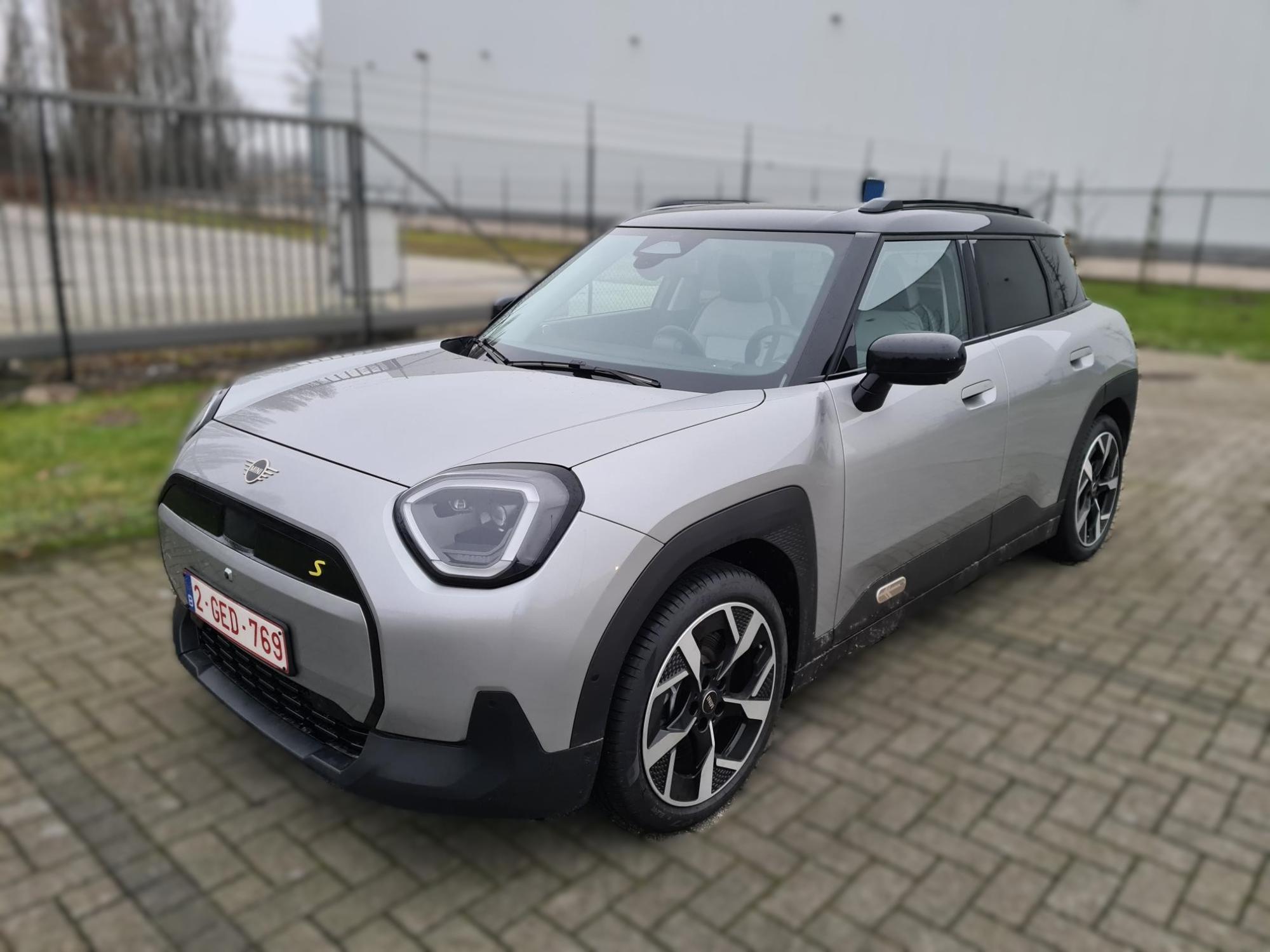
You're a fan of MINI. Your family is growing. The Cooper is getting too small. And you find the Countryman a little too big. Good news: the new Aceman could be the solution. It's 221 mm longer and 54 mm higher than the Cooper SE. Plus, of course, you have more boot space at your disposal.
Unlike its family mates, it is only available in an electric version. It looks a bit more angular than the Cooper SE. Technically, it is identical to the Cooper SE. You can choose from two battery packs notably 38.5 kWh and 49.2 kWh (usable).
We were allowed to test drive the Aceman SE for a week.
General information
- SUV
- Number of seats 5
- Mass in running order 1.785 kg
- LxWxH (mm) 4.079 x 1.754 x 1.514
- Price test vehicle (taxis incl.) - not mentionned
- Cargo volume 300 L / 1.005 L (max)
- Cargo volume frunk 0 L
- Tow Hitch Possible yes (1.600 kg towing braked/750 kg towing onbraked)
- Warranty : 5,6 or 8 years with a maximum of 100,000 or 160,000 depending on the type of car
Driveline
- BEV (Battery Electric Vehicle)
- Battery type Lithium-ion (NMC)
- 54,2 kWh battery capacity (49,2 kWh usable)
- Power 160 kW (286 hp)
- Torque 330 Nm
- FWD (front-wheel drive)
- Architecture 400 V
- EV-platform - Spotlight EV
- Heat pump standard
- V2L : no
Consumption/driving range (WLTP) (CoC)
- Combined consumption 14,5 kWh/100 km
- Combined driving range 391 km
- Driving range city 491 km
Recharging information
- Internal onboard charger 11 kW
- Charging port rear right
- Charge Power AC 11 kW
- Charge Power DC 95 kW max.
- AC : 3 charges
- DC : 4 charges
Test track (104,3 km)
- Non-urban (41 km) 14,6 kWh/100 km
- Motorway (43,1 km) 17,7 kWh/100 km
- City (20,1 km) 15,6 kWh/100 km
- Combined 16,0 kWh/100 km
Test results (974 km)
- Non-urban 15,5 kWh/100 km
- Motorway 16,4 kWh/100km
- City 15,6 kWh/100 km
- Mix 17,0 kWh/100 km
- Combined 16,3 kWh/100 km
Test data
Test drivers
Johan Stevens
974 Testkilometers
Drivetrain
Drivetrain
Platform - SPOTLIGTH EV
Like the Cooper SE, the new electric Mini Aceman SE uses the Spotlight EV platform, which is a joint venture between the BMW Group and Great Wall Motor. BMW Group and Great Wall Motor are promoting e-mobility by building a joint plant in China, where the BMW Group will produce future all-electric models of the MINI brand.
Battery capacity - choice of 2 versions
Here again, we see no difference from the Cooper SE. Depending on which MINI family member and version you choose, you can opt for the 38,5 kWh (E) or the 49.2 kWh (SE and JCW).
- The Aceman E: the entry-level version boasts a net battery capacity of 38.5 kWh (42.5 kWh gross). This guarantees 135 kW (184 hp) of power and 290 Nm of torque. This version will get you between 301 and 309 km, and this according to WLTP.
- The Aceman SE: the slightly more powerful version has a larger net battery capacity of 49.2 kWh (54.2 kWh gross). It results in 160 kW (218 hp) of power and 330 Nm of torque. A larger battery means a greater range of 384-405 km, again according to WLTP.
- The MINI John Cooper Works Aceman: the premium version inspired by MINI's track history. This version has the same battery capacity as the Aceman SE. Power does rise to 190 kW (258 hp) and torque is 350 Nm.
MINI family - take your pick
The new Aceman is only available in the electric version.
Want to discover the extensive range of the Aceman and the other MINI models? Visit MINI.be – De officiële website
Driving modes - MINI Modes - 3
- Green Mode, or Eco driving mode. In this mode, you go for the extra efficient way of driving so you get further on a full battery. This green-tinted mode with green lighting emphasises the more sustainable side of MINI mobility. Power pedal response is optimised for efficient driving. Green Mode is the driving mode for tuning with optimised energy consumption and anticipatory display.
- Core Mode: this mode adds a refined, modern feel to the classic, comfortable MINI driving experience. This driving mode is selected at start-up. When Core Mode is selected, the main menu with the MINI widget is displayed in front. The user interface has the MINI Laguna colour scheme, which is elegant, pure and modern. The Core driving sound is MINI's new branded sound and is the only tone that can be heard not only inside the car, but also from outside (as sound insulation for pedestrians). It is the only tone that is audible. This is engaging, energetic and exciting MINI branding.
- Go-Kart Mode: inspired by the legendary John Cooper Works, MINI's own tuner, this mode offers an exhilarating driving experience with an aesthetic that gets your adrenaline pumping. Kart mode is extremely dynamic and brimming with motorsport DNA. The entire display and interior are cloaked in shades of anthracite and red, while the MINI Interaction Unit is equipped with sporty speed as desired.
MINI Experience modes
In addition, matching colour worlds and patterns are projected onto the dashboard from the rear of the MINI Interaction Unit. With the ‘MINI Experience Modes’ option (SA 4VF), Experience Modes ‘Balance’, ‘Timeless’, ‘Vivid’, ‘ Personal’ are also available.
Regeneration
Recovery is adjustable via the central display. No paddles on the steering wheel. You have a choice of: adaptive/low/medium/high in D mode. You can play a bit with the different levels.
Consumption
The results - overall
After 974 test kilometres aboard the MINI Aceman SE, we arrive at a combined consumption of 16.3 kWh/100 km. This spread over 19 recorded trips. Based on the usable battery capacity of 49.2 kWh, you could theoretically cover a good 302 km* on a charge. The average outside temperature was 1°C. Clearly, outside temperature has a significant impact on consumption and available range.
The results - by road type
- As always, the majority of trips were made on motorways (10 of 19 trips): yielding an average consumption of 16.4 kWh/100 km. Good for a driving range of 300 km*. In total, we covered 759 km on motorways.
- Out of town, on secondary roads, we did 4 trips. Good for 110 km. This results in a combined consumption of 15.5 kWh/100 km. If you can maintain this consumption, you can cover 317 km*.
- Only once did we venture into city traffic: here we stranded on a consumption of 15.6 kWh/100 km. In terms of driving range, this means 315 km*. A short drive of 21 km (test track).
- In addition, another mix of trips on motorway and out of town (secondary roads) yielded a combined consumption of 17.0 kWh/100 km. Good for a driving range of 289 km*. Good for 83 km in total.
- The lowest consumption achieved is 14.6 kWh/100 km and the highest is 18.8 kWh/100 km.
The results - by driving mode
Essentially, during the trips we concentrate on efficient driving making Green Mode the predominant driving mode.
- In 16 out of 19 trips, we opted for Green Mode. It yielded a combined consumption of 16.5 kWh/100 km.
- The Core Mode (1 out of 19 trips) yielded a consumption of 15.1 kWh/100 km.
- We only sampled the Go-kart Mode. Moreover, a short drive. It yields a consumption of 15.5 kWh/100 km respectively.
*The stated driving range is a theoretical calculation based on the usable battery capacity. This is always a snapshot. All kinds of factors such as weather conditions, use of climate control, topography, traffic density and your own driving style can influence this.
Test track
Consumption - general
Let's take a look at how this MNI Aceman SE performs on our test track. We choose the Green experience to go for efficiency. Unfortunately we could not run the test course in one day and this because of the driving range. After 104.3 km, the on-board computer clocked up a combined consumption of 16.0 kWh/100 km on the three parts. This corresponds to a driving range of 308 km* if you could keep this consumption constant. The average outside temperature was 1°C.
Consumption by road type
- the non-urban (secondary roads) section of 41.0 km yields a consumption of 14.6 kWh/100 km. This results in a driving range of 337 km*.
- on the motorway section of 43.1 km, we arrive at a consumption of 17.7 kWh/100 km which is good for a driving range of 278 km*.
- the city journey of 20.1 km is good for a consumption of 15.6 kWh/100 km. This gets you 315 km* on a charge.
Evolution driving range
Unfortunately not possible to calculate correctly as we completed the course in two parts.
- the trip non-urban, we started with a driving range of 131 km and an SoC of 41%. After the ride we had 92 km left and an SoC of 27%.
- after the motorway ride, the driving range had dropped to 28 km and an SoC of 9%.
- started with a driving range of 221 km and an SoC of 77%, the driving range on the 20.1 km stretch dropped to 208 km and the SoC to 70%.
*The stated driving range is a theoretical calculation based on the usable battery capacity. This is always a snapshot. All kinds of factors such as weather conditions, use of climate control, topography, traffic density and your own driving style can influence this.
We strive to drive as efficiently as possible by making maximum use of cruise control (constant speed) and by anticipating traffic situations as much as possible. The speed on motorways is 110 km/h. Energy consumers (such as air conditioning) are turned off when weather conditions permit. In addition, we choose the most efficient driving mode (Eco), if available.
Drive and comfort
New MINI Experience Mode - a completely new MINI experience
As with the MINI Cooper SE, the MINI Aceman SE offers a number of MINI Experience Modes. These do not affect driving characteristics, but they adjust the lighting effects and other aspects of the car's interior to suit your mood.
- Balance Mode: for relaxed driving in a pleasant atmosphere.
- Personal Mode: a mode that offers special personalisation options. For example, you can personalise the background image of the interaction unit.
- Timeless Mode: mode for driving in MINI retro design.
- Vivid Mode: mode for a vivid audio experience and impressive light show in the interior.
Interior
The interior reflects the minimalist design of the original MINI. It is, of course, fully digital.
‘Hey MINI!": the first intelligent personal assistant from MINI
MINI's voice assistant: MINI's intelligent personal assistant can be activated by saying ‘Hey MINI’ or by pressing the voice button on the steering wheel. The system is activated by pressing the voice button on the steering wheel. Voice interaction with the round OLED display takes the form of graphics, typography and animated avatars. On the display, you choose between the stylish MINI and Spike, the new MINI digital assistant Spike. The MINI Intelligent Personal Assistant operates essential MINI functions such as the navigation system, phone and radio, but also controls the temperature. and even regulates the temperature. There may be things you want to know on the road, such as the weather. Or maybe you have a special request. Even if you just want to chat or listen to a joke.
Heads-up display (HUD) - still essential
The HUD undoubtedly promotes safety. The information you need is right in front of you. So you no longer have to look to the side which always means a bit of distraction anyway. What is displayed? Speed, navigation directions, control messages, lists, notifications, driver assistance systems, etc. Would it
Space - more than the Cooper SE
The MINI Aceman SE is one ‘size’ bigger than the MINI Cooper SE. This means you have more space at your disposal. Luggage space ranges from 300 to 1,005 l when you put down the rear seats. Unfortunately, there is still no frunk (front luggage space).
Charging and driving range
Below is an overview of charging sessions. It does note that the battery temperature does play an important role in charging time and capacity. The ‘Prepare battery’ function can be a help here.
Internal on-board charger
The MINI Aceman SE has an 11 kW internal on-board charger. The DC charging capacity is up to 95 kW.
Recharging
We recharged the MINI Cooper SE a total of 7 times.
- Charging sessions AC: 3
- DC charging sessions: 4
Information charging process - for the driver
As a driver, you are sufficiently informed about the evolution of the charging process. The following information is displayed on the screen:
- Estimated charging time (hh:mm)
- Charging power (kW)
- Estimated driving range (km)
- SoC (%) current
- SoC (%) set charge percentage
Pre-conditioning - yes
Cosy to leave with a warmed-up interior. Moreover, this has a positive effect on consumption and driving range.
Charge percentage adjustable - yes
You can set the charging percentage (SoC) via the on-board computer or via the app. MINI recommends charging up to 80% (AC).
Range horizon
The range horizon indicates the extent to which you can influence the range by your current driving style. This
supports an efficient driving style. What is displayed: the current range, the range radius trend, the possible range at very low energy consumption and the possible range at very high energy consumption. Handy.
Advanced Driver Assist Systems (ADAS)
No difference from the MINI Cooper SE at this point. The MINI Aceman SE features 12 ultrasonic sensors and four surround cameras to make parking easier.
Shared moments can be captured with the interior camera's snapshot function and sent to the smartphone via WiFi Direct. The innovative MINI Digital Key Plus option also turns the smartphone into a digital key and facilitates car sharing. In this way, numerous individual vehicle settings can be stored, each ensuring a personalised vehicle experience.
- Assisted Driving Mode : Assisted Driving Mode extends distance control with a steering assistant with lane assistance. The system supports the driver to keep the car within the lane. To do this, the system steers independently if necessary, for example when driving around bends.
- Speed Limit Assist
- Front Collision Warning with braking function
- Exit warning
- Lane Departure Warning
- Lane change warning
- Rear Collision Prevention
- Evasive action
- ...
Driving range simulation (km) based on trip consumption (kWh/100 km), trip length (km) and road type
Based on trip consumption and usable battery capacity, we can simulate the (theoretical) driving range. Although this is always a snapshot, it gives a clear picture of how far you could theoretically drive at a given consumption. Of course, various factors can influence these results.
Comparison WLTP/test results Drivolution
If we compare the consumption results achieved with the WLTP figures, we score less well. This has everything to do with the outside temperature during the test period. A BEV does not really like cold temperatures.
It is important to point out that the figures obtained are always a snapshot. Numerous factors can influence these results.
MINI App
The MINI App deserves nothing but praise. It is a valuable tool to remotely monitor the charging process. Via the remote control, you can also perform quite a few actions: closing windows, doors, ... Moreover, you have a detailed overview of the various trips. You can perfectly check how efficiently you have completed the journey.