Test review DrivOlution MINI Aceman JCW
Test report
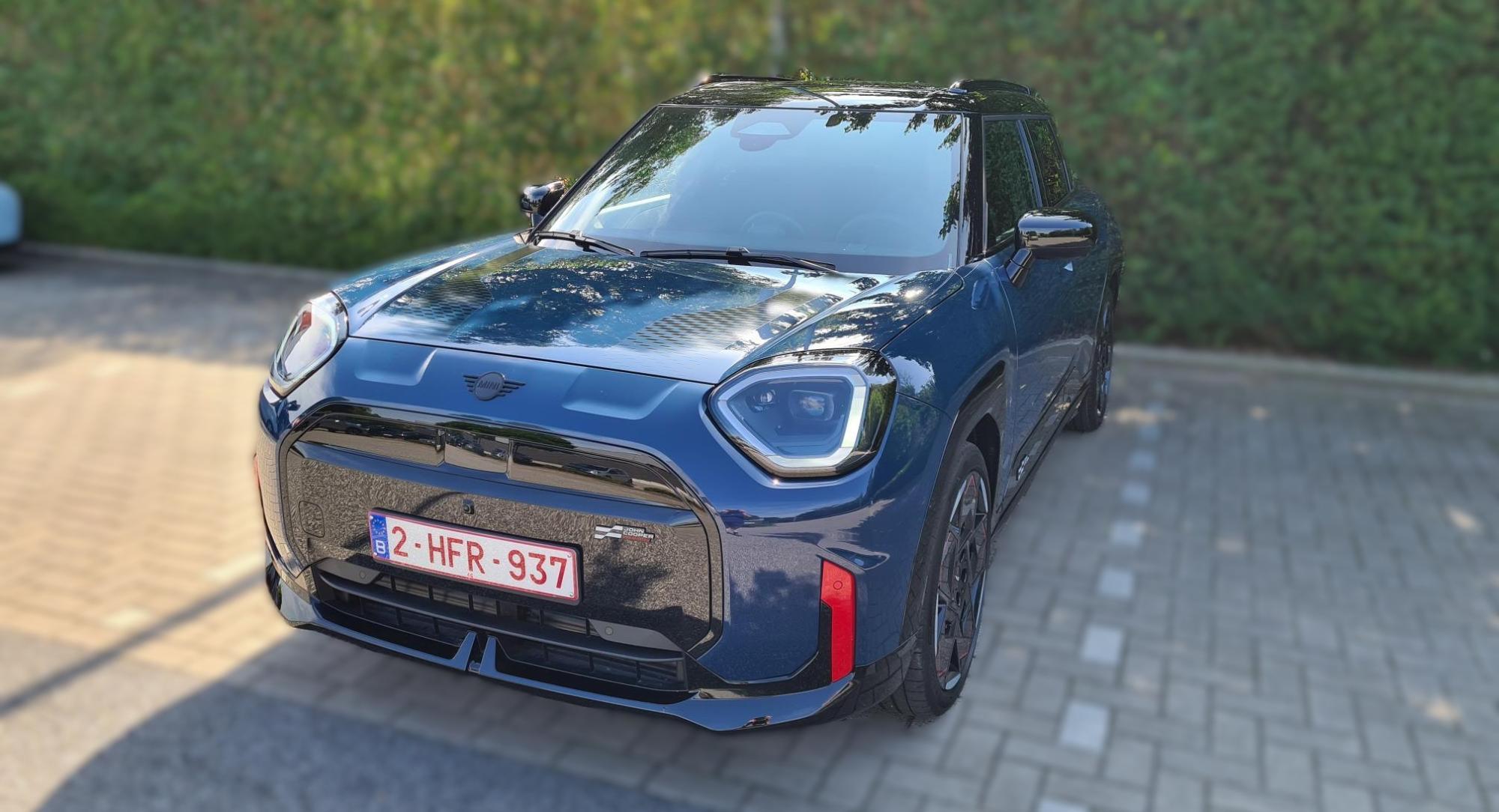
The Mini Aceman JCW is Mini's first electric JCW crossover. It combines excellent driving pleasure with stylish JCW trim and sporty character. Performance is convincing, although range and charging speed are considerably less than some competitors. For fans of Mini's typical handling with zero-emission driving, it offers great value for money.
We had a chance to spend a week out and about with the MINI Aceman - this time in the sporty JCW trim. JCW stands for John Cooper Works, the performance label within MINI, similar to BMW M. Where it used to be all about horsepower and exhaust noise, today JCW is also fully electric. After all, the Aceman is available exclusively as an EV.
How sporty and efficient is this JCW version in practice? And how does it compare to the MINI Aceman SE, the less powerful variant? We went out and compared consumption, driving range and efficiency. Where are the differences?
General information
- SUV Crossover
- Number of seats 5
- Mass in running order 1.825 kg
- LxWxH (mm) 4.079 x 1.754 x 1.514
- Price test vehicle (VATi) 49.120, - euro (based on configuration)
- Cargo volume 300 L / 1.005 L (max)
- Cargo volume frunk 0 L
Driveline
- BEV (Battery Electric Vehicle)
- Battery type Lithium-ion (NMC)
- 54,2 kWh Battery capaciteit (49,2 kWh usable)
- Power 190 kW (258 hp)
- Torque 350 Nm
- FWD (front-wheel drive)
- Architecture 400 V
- Platform SPOTLIGHT EV
Consumption/driving range (WLTP) (CoC)
- Combined consumption 16,4 kWh/100 km
- Combined driving range 345 km
- Driving range city 421 km
Charging information
- Internal onboard charger 11 kW
- Charging port rear right
- Charge Power AC 11 kW
- Charge Power DC 95 kW max.
- AC : 3 charges
- DC : 0 charge
Test track (106,4 km)
- Non-urban (43,4 km) 11,3 kWh/100 km
- Motorway (42,1 km) 15,9 kWh/100 km
- City (20,9 km) 10,2 kWh/100 km
- Combined 12,5 kWh/100 km
Test results (810 km)
- Non-urban 12,6 kWh/100 km
- Motorway 14,4 kWh/100km
- City 10,2 kWh/100 km
- Combined 13,8 kWh/100 km
Test data
Test drivers
Johan Stevens
810 Testkilometers
Drivetrain
Platform
The MINI Aceman JCW is on the "Spotlight EV Platform", which was developed in collaboration between BMW Group and Chinese Great Wall Motors (GWM).
? Key features of the Spotlight EV platform:
Specifically developed for electric cars (no compromise with combustion engines as in older UKL platforms).
Advantages: more interior space relative to exterior dimensions, lower centre of gravity, better battery integration.
Used also for the new MINI Cooper Electric (not for Countryman - which is on the BMW FAAR platform).
MINI Modes: three faces of one character
The MINI Aceman JCW offers three driving modes, each evoking its own mood, dynamics and identity - like driving three MINIs in one:
- Green Mode: the most efficient choice. Green Mode tempers power consumption and helps you drive anticipatively with visual cues and custom regeneration. The subtle green ambient lighting emphasises its sustainable character. Ideal for those who want to maximise their driving range - our favourite mode during testing!
- Core Mode: the default setting at start-up. This mode mixes the classic MINI feel with contemporary flair. Expect balanced tuning, a colourful interface (Laguna theme) and the recognisable MINI "soundscape" that echoes inside and outside. Perfect for everyday use.
- ? Go-Kart Mode: the most playful driving mode. Think sharper steering, more direct throttle response, red interior accents and a sporty soundtrack. Go-Kart Mode totally brings the JCW DNA to life - and shows that electric driving can also be pure driving pleasure.
E-POWER BOOST: when you need a little more punch, such as when accelerating from standstill, e-Power Boost increases the power of your all-electric MINI JCW. The starter motor jumps in to support performance by providing extra power. This allows you to push the pedal all the way down and enjoy maximum driving dynamics.
MINI Experience Modes - create your own atmosphere
In addition to the three driving modes, the MINI Aceman JCW also features the MINI Experience Modes. These take personalisation to the next level by visually transforming not just the digital interface, but the entire interior with it.
Via projection on the dashboard - directly from the rear of the MINI Interaction Unit - unique worlds of light and colour are created to suit your mood or driving style. Choose from atmospheres such as Balance, Timeless, Vivid or Personal, and change the mood in the cockpit at the touch of a button.
Each mode adapts to the driving mode chosen, making screens, lighting and sound form a harmonious whole. This makes every ride not only functional, but also a visual and emotional experience.
Energy recovery: adjustable as required
Again, we see no difference with the other MINIs. The MINI Aceman JCW lets you decide how much the car brakes on the electric motor. Via the central display, in D-mode, you set the level: Adaptive, Low, Medium and High. Paddles on the steering wheel are missing, but the intuitive adjustment via the screen makes it easy to play around with the recovery settings. This allows you to tailor the driving experience perfectly to your preference - from relaxed coasting to near one-pedal driving. In addition, the MINI offers two driving modes via the gear lever: D for natural roll-out and B for strong regenerative braking, ideal for city driving and one-pedal driving. Both settings - driving mode and driving mode - return to their default positions on restart, which seems to be a conscious choice by MINI to start with a neutral base every time.
Consumption
Test consumption MINI Aceman: efficiency in practice
During our week of testing with the all-electric MINI Aceman, we drove a total of 810 kilometres, spread over 16 trips. The weather conditions were mild (average 19 °C) and the test route consisted mainly of motorway traffic (75% of the trips), supplemented by out-of-town trips and a short city drive.
The MINI Aceman recorded an average consumption of 13.8 kWh/100 km, keeping it below the official WLTP value of 16.4 kWh/100 km. The lowest consumption was measured in city traffic (10.2 kWh/100 km), while the highest consumption (15.9 kWh/100 km) corresponded to more intensive highway use.
In terms of driving modes, most of the trips were driven in Green (75% of trips), with additionally a few trips in Core and Go-kart. The differences in consumption by mode are limited, but Green does score most favourably at 13.6 kWh/100 km.
In practice, the Aceman shows itself to be a particularly efficient EV, especially when choosing a calm driving style and the right driving mode. The combination of compact size, regenerative braking and efficient drive makes it suitable for both city traffic and longer motorway trips.
? General test data
- Total test kilometres: 810 km
- Number of rides: 16
- Average outdoor temperature: 19 °C
- Average consumption: 13.8 kWh/100 km
- Lowest consumption: 10.2 kWh/100 km
- Highest consumption: 15.9 kWh/100 km
? WLTP figures (factory reading)
The actual average consumption of 13.8 kWh/100 km is lower than the WLTP value, which is positive.
- Combined consumption (CoC): 16.4 kWh/100 km
- Driving range:
- Mixed: 345 km
- Stad: 421 km
?️ Number of trips by road type
- Motorway: 12 trips (75%)
- Non-urban: 3 trips (19%)
- City: 1 trip (6%)
- Mix: 0 trips
⚡ Average consumption by road type
- City: 10.2 kWh/100 km
- Non-urban: 12.6 kWh/100 km
- Highway: 14.4 kWh/100 km
➡️ Consumption is lowest in the city (typical for EVs due to regenerative braking), and highest on the highway.
? Number of trips per driving mode
- Green (Efficient): 12 trips (75%)
- Core (Normal): 2 rides (12%)
- Go-kart (Sport): 2 journeys (13%)
⚙️ Average consumption per driving mode
- Green: 13.6 kWh/100 km
- Core: 14.4 kWh/100 km
- Go-kart: 14.4 kWh/100 km
➡️ Green mode, as expected, delivers the lowest consumption, although the differences are limited.
? Analysis
- The MINI Aceman performs fewer than stated WLTP values under realistic usage patterns.
- Consumption depends heavily on road type, less on driving mode.
- Green mode was dominantly used, which helps explain the low average.
- Motorway use dominates, making the analysis extra relevant for commuters or fleet use.
Test track
How does the MINI Aceman JCW perform on our 106.4km test course?
To find out, we set out with the most powerful version of the electric Aceman. As always, our set test course combined three driving conditions: out of town, highway and city traffic. The entire drive was driven in Green mode, at 20 °C and without using the climate control. The average consumption over the entire route came to 12.5 kWh/100 km - a fine score for a sporty electric MINI. Handsome consumption leads to a good score in terms of driving range: 395 km*.
Driving sections and consumption by section (road type)
- Non-urban (43.4 km)
▸ Starting driving range: 321 km - ▸ Finishing driving range: 322 km
▸ Average consumption: 11.3 kWh/100 km
▸ If you can adhere to this consumption, you arrive at a driving range of 435 km* and this based on the usable battery capacity of 49.2 kWh. - Motorway (42.1 km)
▸ Start driving range: 322 km - ▸ Final driving range: 268 km
▸ Average consumption: 15.9 kWh/100 km
▸ This gets you 309 km* far on a charge. - City driving range (20.9 km)
▸ Starting driving range: 268 km - ▸ Final driving range: 275 km
▸ Average consumption: 10.2 kWh/100 km
▸ The best consumption score. At this consumption you will get 482 km* far on a charge
Overall test course score
- Total distance: 106.4 km
- Combined consumption: 12.5 kWh/100 km
- Consumption is below WLTP (16.4 kWh/100 km)
Test course summary
This drive confirms what earlier weekly data showed: the MINI Aceman JCW remains remarkably efficient, even with its sporty nature. The fact that its real consumption drops to 12.5 kWh/100 km on a route combining motorway, city and country road traffic underlines its employability for daily use.
The Green mode is essential here and shows that even sporty EVs can be efficient, provided conscious driving behaviour.
Evolution driving range test track
*The stated driving range is a theoretical calculation based on the usable battery capacity. This is always a snapshot. All kinds of factors such as weather conditions, use of air conditioning, topography, traffic density and your own driving style can influence this.
We strive to drive as efficiently as possible by making maximum use of cruise control (constant speed) and by anticipating traffic situations as much as possible. The speed on motorways is 110 km/h. Energy consumers (such as air conditioning) are switched off when weather conditions permit. In addition, we choose the most efficient driving mode (Eco), if available.
Charging and driving range
Charging and driving range - general info
⚡️ General info loading MINI Aceman JCW
- Internal on-board charger AC 11 kW
? AC charging (alternating current)
Load capacity: up to 11 kW (3-phase)
Charge time 0-100%: approx. 6.5 hours
⚡ DC fast charging
Load capacity: up to 130 kW
Charge time (10-80%): approx. 30 minutes
⚡Charge port : right rear
Charging summary - MINI Aceman JCW
Date | From SoC → To SoC | Energy charged | Charging duration |
|---|---|---|---|
30/07/2025 | 27% → 100% | ~43 kWh | 4u 10min |
28/07/2025 | 37% → 100% | ~37 kWh | 3u 38min |
26/07/2025 | 58% → 100% | ~25 kWh | 2u 30min |
- Total number of charging sessions: 3 (AC)
- Total charged energy: ~105 kWh
- Average charging session: ~35 kWh / ± 3h 25min
- Average charging rate (estimated AC): ± 10 kW
? MINI App - insight into your electric driving habits
The MINI App offers a clear and user-friendly interface that allows you, the driver of the Aceman JCW - to effortlessly access all relevant data around your car. These include:
- Charging statistics: charging history, charging costs, charging time and charging status in real time
- Consumption information: average energy consumption per trip or per day, eco-score, driving behaviour analysis
- Charging management: scheduled charging sessions, setting charging timers, preconditioning
- Route planning: integration with charging stations on route via MINI Charging services
- Remote functions: start/stop charging, activate air conditioning remotely, locate car
In short, the MINI App acts as a digital extension of your Aceman and helps you get the most out of your electric driving experience - both in terms of efficiency and comfort.
Drive and comfort
Inside, too, the Aceman JCW stays true to the typical MINI DNA. The eye-catcher is the round OLED screen at the centre of the dashboard, which not only serves as an infotainment display, but also bundles controls for driving modes, navigation and air conditioning. Below the screen we find the familiar toggle switches, still as playful as they are functional. The Experience Modes project colourful patterns on the dashboard, tailored to the selected driving mode - from subtle to pronounced.
The JCW version adds a hearty helping of sportiness: bucket-shaped sports seats with red stitching, a thicker sports steering wheel with JCW logo, dark interior accents and aluminium pedals. The whole thing exudes the same rebellious vibe we know from the other John Cooper Works models, but translated into the electric era.
JCW-specific sports accents
- Sport seats with integrated headrests and JCW upholstery (often combined with alcantara and red stitching).
JCW logos on the seats, door sills and possibly on the steering wheel.
- Sports steering wheel
Thicker, with perforations in the leather.
Contrasting stitching (mostly red).
JCW badge at the bottom of the steering wheel.
- Unique interior accents
Unique patterns or décor panels within the JCW theme.
Dark interior trim, anodised red or carbon-look inserts.
- MINI Experience Modes met extra flair
Pedals and floor mats
aluminium sports pedals.
Mats with red edges or JCW logo.
Driver assistance systems (ADAS)
The MINI Aceman JCW , like its relatives, is equipped with a range of Advanced Driver Assistance Systems (ADAS). Here is an overview of the main features, broken down into categories:
Driver assistance systems - MINI Aceman JCW
- Drive
- Active Cruise Control with Stop & Go → Automatically adjusts speed and stops completely in congestion traffic if necessary.
- Lane Departure Warning → Warns if you unintentionally leave your lane.
- Lane Keeping Assistant → Steers subtly to keep you within the lane.
- Speed Limit Assist → Recognises traffic signs and adjusts speed recommendations on the display or cruise control.
- Forward Collision Warning with Active Brake Assist → Detects risk of collision and brakes automatically if necessary.
- Head-Up Display
- Adaptive LED headlamps with high beam assist
- Navigation with anticipatory speed adaptation via MINI Navigation
- Parking
- Park Distance Control (PDC)
- Reversing camera
- Parking Assistant
- Reversing Assistant →The vehicle remembers the last 50 metres and automatically reverses on the same route - useful in narrow streets or garages.
- Perception & comfort
- Driver Attention Monitoring → Detects signs of fatigue or distraction.
- Cross Traffic Alert (rear) → Warns of traffic from the side when reversing.
- Blind Spot Warning → Warns of vehicles in the blind spot (optional).De rijhulpsystemen werken op een aangename zonder al te opdringerig te zijn.
The driving assistance systems work in a pleasant way without being too intrusive.
Driving range simulation (km) based on trip consumption (kWh/100 km), trip lenght (km) and usable battery capacity (kWh
Theoretical driving range: what does consumption really say?
Based on the measured trip consumption and the usable battery capacity (64.6 kWh net), we can simulate the theoretical driving range. Although this always remains a snapshot, it does give a clear picture of how far you could drive in ideal conditions at a given average consumption.
Of course, there are numerous external factors - such as driving style, temperature, wind, topography and use of heating or air conditioning - that affect this result in practice. Nevertheless, this calculation remains a relevant indicator of the car's efficiency in different driving conditions.
Comparison WLTP/test results Drivolution
Efficiency in practice: consumption and driving range
During our week of testing, the MINI Aceman JCW performed stonishingly more efficiently than the official WLTP figures suggest. While WLTP consumption is quoted at 16.4 kWh/100 km, good for a official driving range of 300 km, in practice we arrived at an average consumption of 13.8 kWh/100 km. This increases the realistic driving range to around 357 km.
During a separate test course with controlled conditions (Green mode, 20 °C, regeneration maximum), consumption even dropped to 12.5 kWh/100 km, which theoretically corresponds to a driving range of 398 km on a full charge.
Important to emphasise: the chosen driving style plays a crucial role in achieving these values. Those who drive consciously and make optimal use of regeneration can therefore get considerably more out of the battery than the standard consumption figures suggest.
MINI Aceman SE versus MINI Aceman JCW
Aceman SE | Aceman JCW | |
|---|---|---|
Power | 160 kW (218 hp) | 190 kW (258 hp) |
Torque | 330 Nm | 350 Nm |
0–100 km/u | 7,1 seconds | 6,4 seconds |
Accu (net) | 49,2 kWh | 49,2 kWh |
WLTP-driving range | ca. 406 km | ca. 355 km |
Comparison test track MINI Aceman SE and MINI Aceman JC
The table clearly shows the consumption difference between the MINI Aceman SE and the MINI Aceman JCW on three types of journeys (out-of-town, motorway and city). Here are a few key points:
MINI Aceman SE (winter) | MINI Aceman JCW (summer) | |
|---|---|---|
Test date | 19/01/2025 | 27/07/2025 |
Non-urban | 14.6 kWh/100 km | 11.3 kWh/100 km |
Motorway | 17.7 kWh/100 km | 15.9 kWh/100 km |
City | 15.6 kWh/100 km | 10.2 kWh/100 km |
Average | 16.0 kWh/100 km | 12.5 kWh/100 km |
Not illogical that consumptions differ. The biggest influencing factor is, of course, seasonal temperatures. The driving style is unchanged.
? Main conclusions
- Analyse
- Seasonal influence: The SE was tested in winter, the JCW in summer. The JCW's lower consumption is partly due to the warmer temperatures, which positively influence battery consumption.
- City consumption: The difference is greatest in the city: 5.4 kWh/100 km less for the JCW. Regeneration and efficiency at low speeds seem to play a stronger role here.
- Highway: Both models show relatively high motorway consumption, although the JCW remains slightly more economical (1.8 kWh difference).
- Average consumption: The JCW is more economical across the board: 12.5 versus 16.0 kWh/100 km, a difference of almost 22%.