Test review DrivOlution BMW M5 Berline
Test report
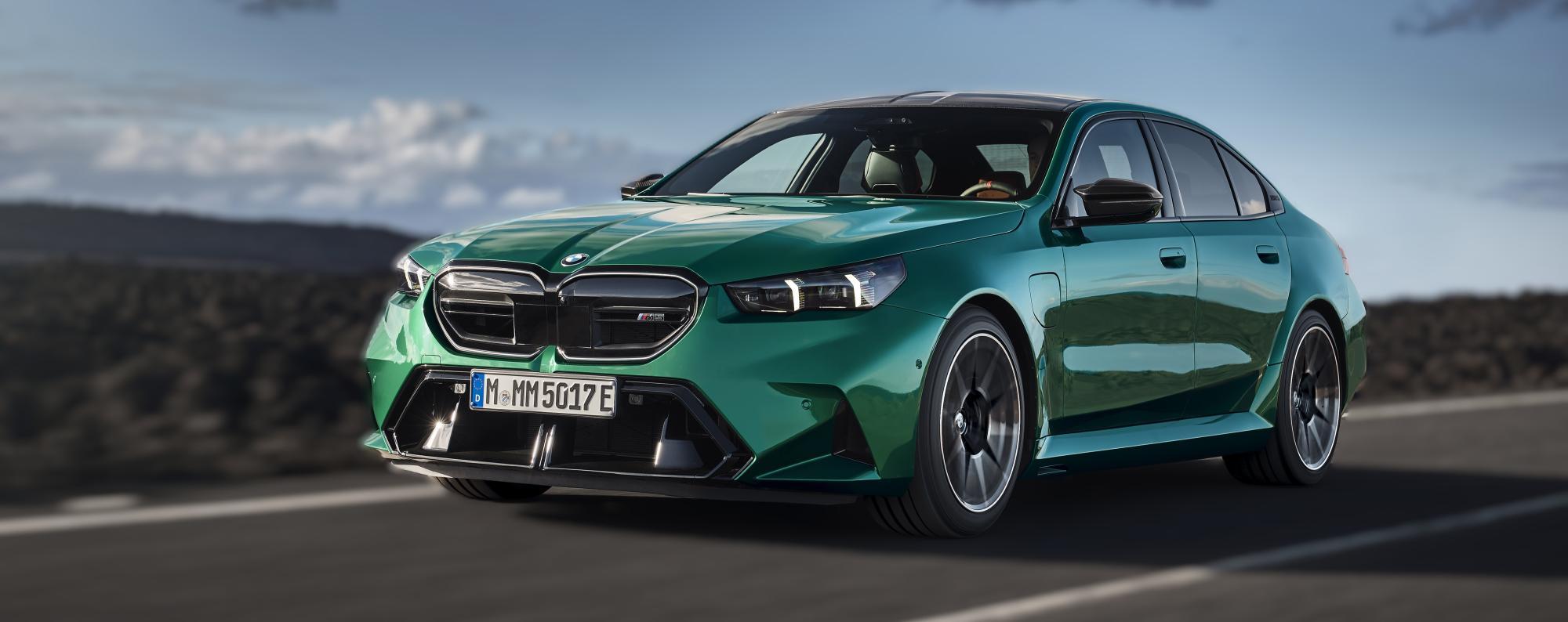
Driving the BMW M5 is no ordinary experience. It’s a swirling mix of raw power and refined luxury, of track-ready performance and everyday usability. A wolf in a tailored suit — or perhaps a suit wrapped around a predator. And that’s exactly what makes it so hard to capture in words. How do you describe a car that transforms from comfortable cruiser to razor-sharp sports sedan at the push of a button? One thing’s for sure: this is no regular test drive. This is an encounter with an icon.
For the first time, the M5 writes a new chapter in its legendary story: it’s now a Plug-in Hybrid. A mighty V8 paired with electric power promises fireworks — and delivers them, too. But in line with our Drivolution DNA, we take a different angle. No high-speed track antics or power slides. Instead, we explore the other side of this machine: how does it cope with real-world driving? Can you drive efficiently without betraying the M5’s soul?
Hybrid? It might sound tame. Sensible. Maybe even boring. But forget everything you think you know. The new BMW M5 does things differently. With 727 horsepower, a roaring V8 and an electric kick, it makes you forget there’s a plug involved at all. This is no green compromise — it’s a shot of pure adrenaline. Ready to find out how the latest M5 bends the laws of physics?
The M badge has stood for uncompromising performance for decades. But in 2025, BMW takes it into new territory. The latest M5 is no longer purely petrol-powered — it's a brutally effective plug-in hybrid, packing 727 hp and 1,000 Nm of torque under your right foot. Electrification doesn’t mean a step back in performance — but it does mark a new chapter in M history. The question is: how does this powerhouse handle on the road? And how do those extra kilos and kilowatts shape the experience?
General information
- Berline
- Number of seats 5
- Mass in running order 2.510 kg
- LxWxH (mm) 5.096 x 1.970 x 1.510
- Price test vehicle (VATi) 153.300, - euro
Driveline
- PHEV (Plug-in Hybrid Electric Vehicle)
- Battery type Lithium-ion (NMC)
- Cylinder capacity 4.395 cm³
- System power 535 kW (727 hp)
- Torque 1.000 Nm
- Number of cylinders 8
- 8-speed automatic transmission
- Fuel tank 60 L
Consumption/range/CO2 (WLTP) (CoC)
- Fuel consumption 1.7 l/100 km
- Electric driving range 68 km (EAER)
- Electric driving range 73 km (EAER City)
- CO2 38 g/km
Test track (107,6 km)
- Non-urban (44,2 km) 18,6 kWh/100 km - 0.0 l/100 km
- Motorway (42,4 km) 5,5 kWh/100 km - 5,8 l/100 km
- City (21,0 km) 16,9 kWh/100 km - 0,0/100 km
- Average consumption 13.7 kWh/100 km - 1.9 l/100 km
Test results (1.040 km)
- Non-urban 14.1 kWh/100 km - 4.7 l/100 km
- Motorway 10.9 kWh/100 km - 4.7 l/100 km
- City 16.9 kWh/100 km - 0.0 l/100 km
- Mix 20.2 kWh/100 km - 0.2 l/100 km
- Combined 12.7 kWh/100 km - 4.1 l/100 km
Test data
Test drivers
Johan Stevens
1040 Testkilometers
Drivetrain
CLAR-platform
De nieuwe BMW M5 Berline (G90) staat, net als de reguliere 5 Reeks (G60), op het modulaire CLAR-platform (Cluster Architecture). Dit platform vormt de ruggengraat van een breed scala aan BMW-modellen en ondersteunt uiteenlopende aandrijflijnen: van traditionele verbrandingsmotoren tot plug-in hybrides en volledig elektrische aandrijvingen.
Dankzij zijn flexibele opzet is CLAR geschikt voor zowel achterwielaandrijving als vierwielaandrijving. Het werd van meet af aan ontworpen met elektrificatie in het achterhoofd en maakt de integratie van batterijpakketten en hybride componenten moeiteloos mogelijk — een ideale basis voor de nieuwe, geëlektrificeerde M5.
? Drivetrain & performance
The M Hybrid plug-in hybrid combines a 4.4 L twin-turbo V8 (approx. 430 kW / 585 hp and 750 Nm) with an integrated electric motor (145 kW / 197 hp and 280 Nm), good for a total system output of 535 kW (727 hp) and maximum 1,000 Nm torque
Sprint from 0-100km/h in 3.5 seconds, top speed limited to 250km/h as standard, optional up to 305km/h with M Driver's Package T
Electric driving range according to WLTP: 63-69 km (max speed up to 140 km/h) with battery of 18.6 kWh
The new BMW M5 Sedan (G90) offers an extensive range of driving modes, affecting both the character of the driveline, the suspension, and the hybrid operation and the hybrid operation. They are all customisable via the BMW iDrive system as well as with the familiar M1/M2 buttons on the steering wheel.
Here are the main modes broken down:
Driving modes hybrid drive train (M HYBRID button)
These determine how the combustion engine and electric motor work together:
- HYBRID
- Default mode
- Dynamic balance between petrol engine and electric motor
- Efficient in normal driving, but switches quickly to V8 when power is needed
- ELECTRIC
- All-electric driving
- Up to 140 km/h possible
- Up to approx. 69 km WLTP driving range
- Perfect for city traffic or emission-free zones
- eCONTROL
- Keeps the battery charged (charges actively via the V8)
- Useful for those who want to drive electric at the end of the drive (e.g. in cities)
?️ M driving modes & M Setup
Deze sturen motorrespons, ophanging, stuurgevoel, remgevoel, transmissiegedrag én xDrive-aansturing:
- ROAD
- Most comfortable driving mode
- Maximum assistance systems enabled
- Ideal for daily rides
- SPORT
- Instant throttle response
- Tighter steering feel and chassis
- More emphasis on rear-wheel drive via M xDrive
- Limited intervention of driving assistance systems
- TRACK (only in combination with M Drive Professional)
- All assistance systems are switched off
- Display changes to track-specific info (such as lap times)
- Pure, unadulterated M experience
⚙️ Additional settings via M Setup menu
Here you put together your own combinations for:
- Motor: Efficient / Sport / Sport Plus
- Other: Comfort / Sport / Sport Plus
- Stuur: Comfort / Sport
- Brakes: Comfort / Sport
- M xDrive: 4WD / 4WD Sport / 2WD (fully rear-wheel drive)
- ESP: On / MDM / Off
You can save these settings under M1 and M2 for quick access via the steering wheel.
✅ Summary:
Functional area | Drive mode |
|---|---|
Hybrid system (M HYBRID) | HYBRID / ELECTRIC / eCONTROL |
Driving dynamics (M MODE) | ROAD / SPORT / TRACK |
M Setup Customizable | Engine, suspension, steering, brakes, M xDrive |
Quick presets | M1 & M2 on the steering wheel |
Consumption
Consumption analysis - BMW M5 Plug-in Hybrid
During our test period with the BMW M5 PHEV a total distance of 1,040 kilometres was covered and this was spread over 16 trips. The majority of the trips took place on motorways (63%), followed by out-of-town (25%). Only one trip took place in city traffic (6%), as did one mixed-profile trip (6%).
Consumption overall
According to the on-board computer, the average consumption was:
- 4.1 l/100 km of petrol,
- 12.7 kWh/100 km of electricity.
When converting electric consumption to petrol equivalent (1 litre = ±8.5 kWh), the total practical consumption comes out at 5.6 l/100 km. This value corresponds exactly to the effectively measured consumption based on litres refuelled and distance travelled.
Average fuel and electricity consumption by road type was as follows:
Non-urban: 4.7 l/100 km and 14.1 kWh/100 km electric
Motorway: 4.7 l/100 km petrol and 10.9 kWh/100 km electric
City: 0.0 l/100 km petrol and 16.9 kWh/100 km electric
Mixed: 0.2 l/100 km petrol and 20.2 kWh/100 km electric
Road Type | Petrol (l/100 km) | Electric (kWh/100 km) | Electric Equivalent (l/100 km) | Total (l/100 km) |
|---|---|---|---|---|
Non-urban | 4.7 | 14.1 | 1.62 | 6.32 |
Motorway | 4.7 | 10.9 | 1.25 | 5.95 |
City | 0.0 | 16.9 | 1.94 | 1.94 |
Mixed | 0.2 | 20.2 | 2.32 | 2.52 |
The consumption figures per drive mode show clear differences:
As for the drive modes, the most frequently selected was Hybrid mode (62% of trips), followed by M2 mode (19%) and Dynamic Plus (13%). The Hybrid & Electric mode was used for just one trip (6%).
Hybrid & Electric: 4.3 l/100 km petrol and 13.0 kWh/100 km electric
Hybrid: 3.5 l/100 km petrol and 13.8 kWh/100 km electric
Dynamic Plus: 10.9 l/100 km petrol and 13.8 kWh/100 km electric
M2: 0.1 l/100 km petrol and 18.6 kWh/100 km electric
Drive Mode | Petrol (l/100 km) | Electric (kWh/100 km) | Electric Equivalent (l/100 km) | Total (l/100 km) |
|---|---|---|---|---|
Hybrid & Electric | 4.3 | 13.0 | 1.49 | 5.79 |
Hybrid | 3.5 | 13.8 | 1.59 | 5.09 |
Dynamic Plus | 10.9 | 13.8 | 1.59 | 12.49 |
M2 | 0.1 | 18.6 | 2.14 | 2.24 |
When converting electric consumption to petrol equivalent (1 litre = ±8.5 kWh), the total practical consumption comes out at 5.6 l/100 km. This value corresponds exactly to the effectively measured consumption based on litres refuelled and distance travelled.
The data clearly show how the plug-in hybrid system uses energy efficiently: on shorter journeys and city traffic, it drives almost exclusively electric, while on longer journeys and with dynamic driving styles, the combustion engine assumes its role.
Viewing this for a moment with the refuelled volume, we get the following calculation.
Total volume refuelled: 54.01 litres
Number of kilometres driven: 964 km
Average consumption: 5.6 l/100 km
Here is the graph showing the average consumption of the BMW M5: 5.6 l/100 km.
Test track
During our test track, we focused on making the most efficient drive possible - even with a powerful sedan like the BMW M5. The result? An average overall consumption of 3.5 l/100 km in petrol equivalent, thanks to clever use of the electric drive. On out-of-town stretches and in urban traffic, it even drove fully electric.
? BMW M5 Plug-in hybrid: electric where it can, petrol where it must
During our 107.6-kilometre test course, the new BMW M5 showed surprising efficiency in utilising its electric drive. In the city and on secondary roads, we drove fully electric, good for a total 69.3 kilometres without a single drop of petrol. On the motorway - in Hybrid mode - the power was split between both power sources, with an estimated further 4 kilometres driven electrically s.
The result?
✅ 64% of the trip fully electric
⛽ Only 36% on petrol, mainly at higher speeds on the motorway.
These figures illustrate how far a powerful plug-in hybrid like the M5 can go in reducing fuel consumption without sacrificing dynamics.
Driving consumption analysis BMW M5 (plug-in hybrid)
1. M² mode - Out of town - pure electric (configuration)
Travel length: 44.2 km
Electric consumption: 18.6 kWh/100 km (= 2.1 l/100 km equivalent petrol consumption)
Gasoline consumption: 0.0 l/100 km
Analysis: The drive was fully electric, which makes sense in this sporty, EV-priority driving mode. Consumption is quite high, perhaps due to dynamic driving style or altitude changes.
2. Hybrid mode - Autosnel path
Ride length: 42.4 km
Electric consumption: 5.5 kWh/100 km (= 0.6 l/100 km equivalent petrol consumption)
Gasoline consumption: 5.8 l/100 km
Analysis: A conscious decision to choose hybrid mode, with the intention of saving battery power for city driving. Here is balanced use of both powertrains. For motorway use, this is remarkably low combined consumption for a car with V8 performance.
3. M² mode - City - pure electric (configuration)
Travel length: 21 km
Electric consumption: 16.9 kWh/100 km (= 1.9 l/100 km equivalent petrol consumption)
Fuel consumption: 0.0 l/100 km
Analysis: Again, driven fully electric. The higher consumption spike suits city traffic with a lot of acceleration.
? Summary total:
Drive | Number of km |
|---|---|
Electric | 44.2 + 4.1 + 21.0 = 69.3 km |
Fuel | 38.3 kilometres |
? Total distance driven: 44.2 + 42.4 + 21.0 = 107.6 km
? Electric share: ~64%
⛽ Benzoline share: ~36%
Decrease in range by segment
Road type | Hybrid dungeon (km) | Electric dungeon (km) |
|---|---|---|
Non-urban | 354 - 326 = 28 | 70 - 42 = 28 |
Motorway | 326 - 288 = 38 | 42 - 33 = 9 |
City | 288 - 274 = 14 | 33 - 19 = 14 |
? Data explanation
In this table, the electric consumption is converted into consumption in litres of fuel per 100 km (with a factor of about 1 litre of fuel ≈ 8.7 kWh). This gives you a realistic total consumption that combines the two energy sources.
Converted consumption per trip:
Road type | Total consumption (l/100 km,recalculated) |
|---|---|
Non-urban | 2,1 |
Motorway | 6,4 |
City | 1,9 |
✅ Average combined consumption over all journeys: 3.5 l/100 km
? BMW M5 Plug-in hybrid: impressively low overall consumption
Reducing both electric and petrol consumption to a single measure - a petrol equivalent - reveals just how efficient the new BMW M5 really is.
- In city traffic, converted consumption was limited to 1.9 l/100 km.
- Non-urban was only 2.1 l/100 km
- On the highway, combined fuel consumption ran as high as 6.4 l/100 km, due to the larger role of the V8
➡️ Averaged over the entire test course, overall consumption came to just 3.5 l/100 km.
An astonishingly low figure, especially for a sports sedan with 727 hp.
Drive and comfort
⚖️ The M5 as a dual personality
Here, BMW really lets you choose between roar or glide. And that can be per trip, per situation - or even within the same trip.
From ELECTRIC mode in a traffic jam, to 4WD Sport with V8 roar on a twisty mountain road.
A dilemma? Absolutely.
But also a wealth of choice -something a classic M5 never offered before.
Interior
Inside, the M5 impressively combines high-performance with high-tech luxury. The dashboard is dominated by the curved BMW Curved Display with the latest Operating System 8.5, including M-specific graphics. The sport seats offer excellent lateral support as well as comfort for long journeys, with options such as ventilation and massage. There are subtle M details everywhere: contrast stitching, carbon accents, illuminated M logos. The atmosphere is sporty, but not spartan - rather modern, sleek and high-quality. And despite the brutal performance, it is remarkably quiet here, unless, of course, you wake up the V8.
HUD is fantastisch
The head-up display also deserves praise. In true M style, it is large, razor-sharp and perfectly positioned in your field of vision. Navigation instructions, speed as well as M-specific info such as RPM or gear shift indicator are projected clearly and neatly. Even in full sunlight, everything remains perfectly legible - a real added value during sporty or concentrated driving.
iDrive Controller
The iDrive controller in the new BMW M5 (G90) is the central control instrument for the infotainment system and various vehicle functions. The iDrive controller is located on the centre console and, together with the curved display, forms the heart of the infotainment system. Using the push-and-spring rotary knob, you intuitively navigate through menus without taking your eyes off the road for long periods of time. Additional shortcut keys and a touch-sensitive surface make operation even more efficient. You keep the central screen clean.
Charging and driving range
? Charging behaviour and electric driving range
Those who want to make the most of the BMW M5's electric potential would do well to charge the battery regularly. The plug-in hybrid has a net battery capacity of 18.6 kWh and can AC charge up to 7.4 kW. In practice, this means that a full charge takes around 2.5 hours ideal for charging the car after work, so you leave the next morning with a full battery.
During our test period, 6 effective charging sessions took place, accounting for a total about 111 kWh of charged power. An average charging session thus yielded about 18.5 kWh on average. Charging was mainly done at a fixed AC point at home or at the office (Merelbeke-Melle), each time with the air conditioning switched off.
Each full charge resulted in a charged driving range of about 69-70 kilometres. This makes the M5 excellent for daily trips in and around the city. Thanks to this driving range, it is possible to largely cover commuter journeys electrically, without the need for interim charging.
Also striking is the consistent charging efficiency: the difference between charging state at the start and completion of each session indicates a reliable charging curve. The MyBMW app also provides a clear overview of the charging process, so you always have a view of remaining charging time and available driving range.
Date (start) | Start SOC | Eind SOC | Energie (kWh) | Duration | Driving range start | Driving range end |
21/07/2025 21:07 | 5% | 100% | ~21 kWh | 2u 50min | 3 | 70 |
20/07/2025 18:56 | 31% | 100% | ~15 kWh | 2u 04min | 21 | 70 |
20/07/2025 12:56 | 28% | 100% | ~16 kWh | 2u 12min | 21 | 70 |
17/07/2025 17:28 | 5% | 100% | ~21 kWh | 2u 54min | 2 | 70 |
16/07/2025 21:47 | 31% | 31% | 0 kWh | 0 min | ? | 70 |
14/07/2025 18:02 | 21% | 100% | ~17 kWh | 2u 26min | 14 | 70 |
Overview of fuel consumption and electri consumption per trip
Smart switching between power and efficiency
The BMW M5 plug-in hybrid proves remarkably versatile. In ELECTRIC mode you drive smoothly and emission-free - with consumption from 0.0 l/100 km and around 13 kWh/100 km.
If you put the V8 to work in Dynamic Plus, the figures rise sharply: up to 9.4 l/100 km and 20+ kWh/100 km. But even in hybrid mode, it remains efficient - even on longer journeys.
Want to maximise electric driving? Then charging is essential. Yet the M5 surprises: even with an almost empty battery, you can still cover a stretch electrically, thanks to smart energy control.
ADAS (Advanced Driving Assist Systems)
The new BMW M5 G90 is not only a high-performance sports sedan, but also a technological flagship. It is packed with driving assistance systems, many of which are standard, and others as part of the optional Driving Assistant Professional package.
Key driving assistance systems in the M5
✅ Standard feature:
Active Cruise Control with Stop & Go
- Automatically maintains distance and can come to a complete stop and start againLane Departure Warning met actieve correctie
Speed Limit Assist (recognises and adjusts speed)
Parking assistant with reversing camera
Front Collision Warning (pedestrians, cyclists, vehicles)
Rear Cross Traffic Alert & exit parking warning
? Optioneel (Driving Assistant Professional):
Active lane assistant - Self-driving on motorway and keeping you perfectly centred
Automatic navigation-based speed adaptation (Predictive ACC) - Adjusts speed for curves, roundabouts, exits
Active Navigation Guidance - Actively guides towards lane change at complex motorway junctions
Lane Change Assistant (automatic indicator change)
Emergency Stop Assistant - Gets the car to a controlled stop if the driver becomes unwell
Remote Parking & Manoeuvre Assistant - Lets you park your car remotely via smartphone
?️ Tabular overview
Systeem | Standaard / Optioneel |
|---|---|
Adaptive Cruise Control (Stop&Go) | ✅ Standard |
Lane Departure Warning | ✅ Standard |
Parking assistant & reversing camera | ✅ Standard |
Active lane assist | ? Optional (Driving Assistant Prof.) |
Predictive speed control | ?Optional |
Lane Change Assistant | ? Optional |
Remote Parking & Manoeuvre Assist | ? Optional |
The M5 offers everything from classic driving assistance systems to semi-autonomous highway assistance, but always leaves the driver at the centre of attention. Like its drive, the technology is double-sided: assistance when you want it, pure control when you feel like it.
BMW App
The BMW App provides a clear and comprehensive overview of your charging history, driving performance and efficiency. Every journey is analysed, every charge neatly logged. Every month, you also receive an overview with consumption and charging statistics. In short: a smart source of insight for those who like to optimise their driving behaviour.