Test review DrivOlution BMW 330e Touring
Test report
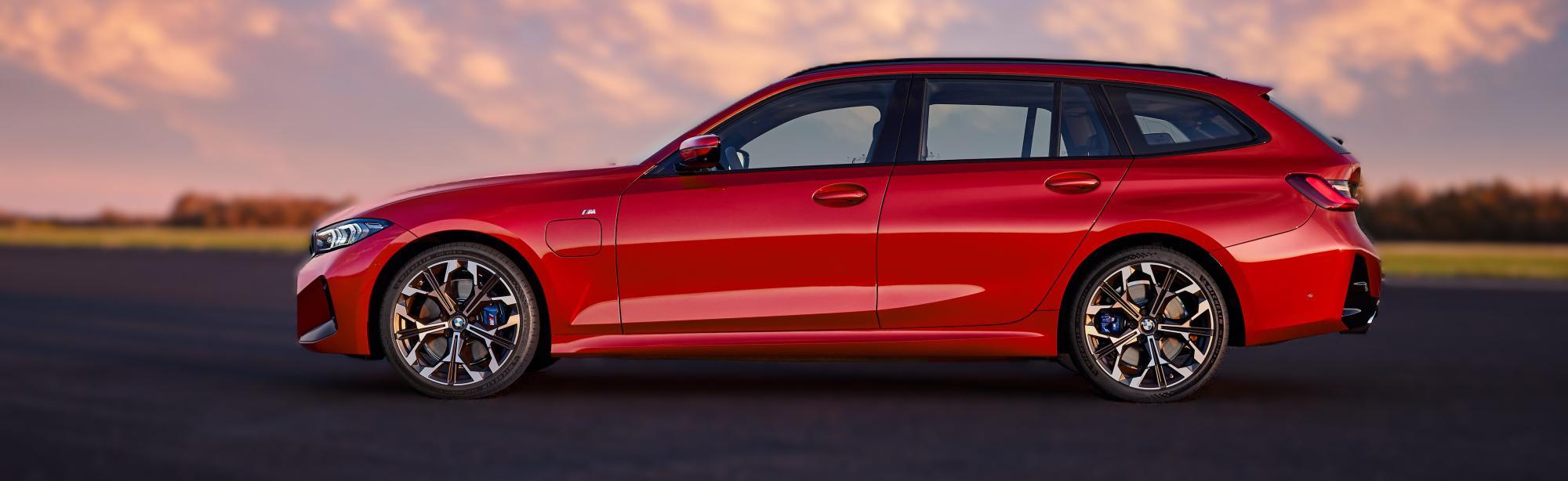
For almost 50 years, the BMW 3 Series has been the beating heart of the brand - an icon that embodies driving pleasure, precision and character. At a time when electric SUVs dominate the streetscape, the 3 Series Touring remains an alluring alternative for those who appreciate sportiness, elegance and versatility. Within BMW's "Power of Choice" strategy, the 330e Touring offers a compelling blend of tradition and future.
We spent a week on the road with this plug-in hybrid to discover how it performs in practice.
General information
- Touring
- Number of seats 5
- Mass in running order 1.970 kg
- LxWxH (mm) 4.713 x 1.827 x 1.448
- Tow hitch possible yes (braked 1.500 kg - unbraked 750 kg)
- Trunk volume 410L/1.420 L (max)
- Price test vehicle (taxes included) 75.000, - euro
Driveline
- PHEV (Plug-in Hybrid Electric Vehicle)
- Petrol engine 4 cylinder - 1998 cm³
- Battery type Lithium-ion
- Net battery capacity 19,5 kWh
- Power total powertrain 215 kW (292 hp)
- Power combustion engine 135 kW (184 pk)
- Power electric engine 80 kW (109 pk)
- Torque total powertrain 420 Nm
- 8-speed automatic transmission
- RWD (Rear-wheel-drive)
- EV-specific platform no
Consumption/driving range/CO2 (WLTP) (CoC)
- Combined fuel consumption 7.4 /100 km
- Combined elektric Consumption 21,9 kWh/100 km
- Electric driving range 95 km (EAER)
- Electric driving range city 99 km (EAER City)
- CO2 21 g/km (weighted combined)
Test track (107,8 km)
- Non-urban (42,5 km) 0,0 l/100 km / 16,7 kWh/100 km
- Motorway (44,0 km) 1,2 l/100 km / 14,0 kWh/100 km
- City (21,3 km) 0,0/100 km / 16,6 kWh/100 km
- Combined 0,4 l/100 km / 15,8 kWh/100 km
Test results (633 km)
- Non-urban 20,0 l/100 km / 0,8 kWh/100 km
- Motorway 1,0 l/100 km / 16,1 kWh/100 km
- City 0,0 l/100 km / 16,6 kWh/100 km
- Mix 2,1 l/100 km / 12,2 kWh/100 km
Test data
Test drivers
Johan Stevens
633 Testkilometers
Drivetrain
Powertrain: plug-in hybrid power with a focus on efficiency
The BMW 330e Touring is equipped with an advanced plug-in hybrid powertrain (PHEV) that combines the best of both worlds. Under the bonnet is a powerful 2.0-litre four-cylinder petrol engine, coupled with an 80 kW (109 hp) electric motor. Together, they produce a system output of 215 kW (292 hp) and 420 Nm of torque - enough for smooth performance in any situation.
Energy for the electric motor comes from a lithium-ion battery with a net usable capacity of 19.5 kWh, providing a considerable electric driving range, ideal for everyday use. Shifting is via an 8-speed automatic transmission, which shifts smoothly and contributes to the car's comfortable character.
Although the 330e uses a modified platform to incorporate PHEV technology, it is not an EV-specific platform like fully electric models. Still, it offers a good compromise between space, performance and electrification.
For those who want extra traction and stability, the BMW 330e is also available as an xDrive variant with all-wheel drive. This version offers the same performance as the rear-wheel-drive model, but adds extra grip and security in a variety of driving conditions - from wet roads to twisty mountain passes. The powertrain and system power remain identical, ensuring driving pleasure and efficiency remain undiminished.
Driving modes - efficiency or dynamics of your choice
The BMW 330e Touring offers a wide range of driving modes, each with its own character and purpose. Depending on driving conditions and your preference, you can choose maximum efficiency or pronounced dynamics or a mix.
- HYBRID : in standard HYBRID mode, the system automatically selects the most efficient drive mode - electric, combustion engine or a combination of both - depending on the driving situation. As a driver, you don't need to intervene: the software continuously determines the optimal powertrain for economical and smooth driving.
- HYBRID ECO PRO: this variant of hybrid mode puts extra emphasis on an economical driving style. Engine response, climate control and other comfort systems are adjusted to further reduce consumption. Ideal for those who want to save every drop of fuel - or kWh.
- ELECTRIC: in ELECTRIC mode, the 330e drives completely emission-free, powered by the electric motor. This is the ideal mode for city traffic or environmental zones. If the driver accelerates briskly (kickdown), the system automatically switches to the combustion engine and returns to the last used hybrid mode. Our favourite!
- Battery Hold: this feature allows the current battery charge to be preserved for later use - for example, when you want to save part of the drive for fully electric driving in the city. The combustion engine then temporarily takes over to conserve the battery.
- SPORT: If you like to drive a bit sharper, SPORT mode offers a more dynamic tuning. The suspension, drive train and response are sharpened for more agility and sportier handling.
- XTRABOOST: in SPORT mode, extra power can be temporarily released via the electric motor, thanks to the XTRABOOST function. This feature provides remarkably direct acceleration and extra driving dynamics when needed.
Both the Sport and the Xtraboost we didn't really try out. Our focus was different.
Overview of road type & selected driving mode
Let's take a look at the recorded trips by road type and selected driving mode.
Per road type
- Non-urban: the majority of trips were driven outside the city: 9 out of 19.
- Motorway: 7 trips
- City: only 1 city trip
- Mix: 2 trips are a mix of motorway and secondary roads.
By driving mode
- Electric: 13 (69%) of the 19 trips we were able to drive purely electrically.
- Hybrid represented 4 trips (21%)
- Battery Hold we selected only 1 (5%) time to preserve the battery status
- Electric & Hybrid also selected 1 time and this because of an empty battery.
However, it is interesting to note that despite a zero electric range, the hybrid system remains active. So a dead battery does not necessarily mean driving on petrol.
Consumption (general
Driving a Plug-in Hybrid Electric Vehicle (PHEV) requires a different way of thinking. It is far from easy to make a pure comparison between fossil and electric driving. Many factors - from the type of road and traffic density to weather conditions and the use of air conditioning - have a direct influence on consumption. The role of the driver should not be underestimated either: those who drive with anticipation and make smart use of the available electric range clearly get more efficiency out of the hybrid powertrain.
During our test with the BMW 330e Touring, we covered a total of 633 kilometres. The average petrol consumption thereby came to a particularly low 1.0 litres per 100 kilometres. In addition, we noted an average electric consumption of 17.6 kWh per 100 kilometres.
To get a complete picture of actual efficiency, we converted the electric consumption to a petrol equivalent. Based on a conversion factor of 8.7 kWh per litre of petrol, that works out to about 2.0 litres per 100 kilometres.
If you add both values together, the total average consumption over the entire drive is 3.0 litres per 100 kilometres in petrol equivalent. An impressive score, especially for a spacious plug-in hybrid family car like the 330e Touring.
Petrol/electric consumption per recorded trip
It is always in our intention to maximise electric driving. Let's take a look at the results for each ride.
✅ Fully electric rides (Electric)
We were able to complete trips 2, 3, 5, 7, 10, 11, 13, 15-19 fully electric, with electric consumption ranging from 16.6 to 30.3 kWh/100 km with petrol consumption of 0.0 l/100 km.
The highest values are:
Trip 7: 30.3 kWh/100 km (3.5 l/100 km equivalent)
Trip 15: 25.7 kWh/100 km (3.0 l/100 km equivalent)
♻️ Hybrid trips (Hybrid)
Rides 1, 4, 6, 14 show combined petrol and electricity use.
Trip 1 has the highest total petrol equivalent of 5.8 l/100 km, mainly due to a relatively high petrol consumption of 5.7 l/100 km.
Hybrid rides are relatively inefficient when running largely on petrol.
? Battery Hold mode
Only Trip 9 has this mode. The purpose of this mode is to maintain the battery level. This allows you to drive electric whenever it is desirable. Motorway driving on the petrol engine is more ecologically acceptable than in the city.
Petrol: 4.2 l/100 km
Electric: 4.4 kWh/100 km
Total equivalent: 4.7 l/100 km
This shows that "Battery Hold" mode results in more fossil consumption, possibly because electric driving is delayed. Logical consequence yet in the end these are not bad figures for a petrol car.
? Electric & Hybrid
Trip 12 is the only one to combine both modes.
Electric: 12.4 kWh/100 km - equivalent petrol consumption: 1.4 l/100 km
Petrol: 2.3 l/100 km
Total: 3.7 l/100 km
Reasonably high, but better than Battery Hold and some hybrid trips.
By road type
There are 4 road types: Highway, Out of town, City, Mix.
Notable:
Highway rides (such as Rides 1, 4, 15-19) have low electric efficiency. For example, Trip 15 consumes 25.7 kWh/100 km, which is relatively high.
Non-urban trips vary widely. Electric consumption is between 12-30 kWh/100 km.
City trips (Trip 5): only 16.6 kWh/100 km, which is quite efficient.
Conclusions
- All-electric trips are the most energy-efficient.
- Motorway trips are also perfectly possible in electric drive mode if the drive is not too long, the battery is fully charged and you use the accelerator in a measured way.
- The more you have to engage the combustion engine, the higher the consumption.
- Battery Hold mode can help you maintain battery levels.
Efficiency varies greatly from ride to ride - route choice, driving style and mode choice are determining factors.
Test track
Let's take a look at how the BMW 330e Touring performs on our test track. We look at how to maximise electric driving.
Overall
After 107.8 km, we arrive at the following results: combined fuel consumption is 0.4 l/100 km over the three parts. The electric consumption is 15.8 kWh/100 km. If we recalculate the electric consumption to equivalent petrol consumption, we arrive at 1.8 l/100 km.
Consumption by road type
- Non-urban: we were able to drive the entire trip purely electric. Petrol consumption is 0.0 l/100 km, and electric consumption is 16.7 kWh/100 km. This corresponds to an equivalent petrol consumption of 1.9 l/100 km. The driving mode chosen is electric.
- Motorway: a slightly different picture. In order not to drain the battery, we choose the "Battery hold and Hybrid" driving mode. The drive is done entirely on petrol engine. It delivers the following results: 1.2 l/100 km and 14.0 kWh/100 km. The last kilometres are within built-up areas where the powertrain still chooses electric.
- City: the city drive we were again able to drive fully electric. No petrol consumption and electric consumption clocked in at 16.6 kWh/100 km. Converted, this means 1.9 l/100 km.
We mention here that both the selected driving mode and the use of climate control indicate quite a difference in terms of combined range and electric driving range.
Driving range evolution
This is an important parameter especially in the context of a PHEV. We started with a fully charged battery (SoC 100%). The range of the hybrid system (petrol and electric) was 521 km and 83 km of electric driving range (with climate control not switched on). When the climate control was switched on, the values were 506 km and 68 km. So quite a difference.
We aim to drive as efficiently as possible by maximising the use of cruise control (constant speed) and anticipating traffic situations to the maximum. The speed on motorways is 110 km/h. Energy consumers (such as air conditioning) are switched off when weather conditions permit. In addition, we choose the most efficient driving mode (Eco), if available.
Drive and comfort
Familiar BMW atmosphere
As soon as you get in, you are immersed in the familiar BMW atmosphere. The finish, as we would expect from the brand, is of a high standard: clean lines, quality materials and thoughtful interior design.
The seating position is excellent, with sufficient support and adjustability. Still, we miss the electric seat adjustment with memory function - a comfort option that really shouldn't be missing in this segment.
The head-up display leaves a strong impression: bright, clear and perfectly positioned. Ergonomics are generally very good. Operation of the steering wheel buttons, including for adaptive cruise control, is intuitive. At the same time, it is noticeable that BMW, like so many brands, is housing more and more functions in the central touchscreen. This makes for a sleek-looking dashboard, but sometimes requires extra attention while driving.
Space - from 420 L to 1,420 L
Inside, there is plenty of space, both in the front and in the rear. The boot offers a volume of 420 litres and grows to 1,420 litres with the rear seats folded down - figures that underline the versatility of this 330e Touring.
On the technology front, the new QuickSelect start-up screen is particularly striking. It works quickly and logically, and thanks to the BMW Operating System 8.5, most functions can be accessed with a few taps. The BMW Personal Assistant also received a major upgrade and now understands a wider range of voice commands - convenient and safe while driving.
Split tailgate - convenient
Finally, the split tailgate deserves praise. This allows you to quickly put something in the boot without having to open the entire lid - a small detail, but extremely practical in everyday use.
ADAS (Advanced Driving Assist Systems)
Driving assistance systems are certainly not lacking in this BMW 330e Touring. An overview:
Rijhulpsystemen (actieve veiligheid)
- Driving Assistant Professional:
- Steering & Lane Control Assistant (incl. queue assistant up to approx. 60 km/h)
- Active Lane Keeping Assistant with active side impact protection
- Emergency Stop Assistant
- Automatic Speed Limit Assist
- Navigation-assisted speed adaptation
- Lane Change Assistant (automatic lane change)
- Traffic Jam Assistant (semi-autonomous driving in traffic jams)
- Front Collision Warning with braking intervention
- Lane Departure en Lane Change Warning
- Rear Cross Traffic Alert & Rear Collision Prevention
- Speed Limit Info with overtaking detection
- Adaptive Cruise Control with Stop & Go function
- Park Assistant / Parking Assistant Plus
Standaard dynamische systemen
- DSC incl. ABS, DTC, CBC & DBC
- Performance Control & Dry Braking
- Start-Off Assistant
Passive safety (standard)
- Multiple airbags (front, side, head airbags)
- Three-point belts with belt tensioners and force limiters
- Active head restraints
- Tyre pressure display
The driving assistance systems, such as Speed Limit Assist, function in a pleasant and non-intrusive way. The 'Driving Assistant Professional' system enhances both driving comfort and safety.
Recharging and electric range
BMW 330e Touring: plug-in hybrid requires maximum charging discipline for maximum electric efficiency
Anyone wanting to get the most out of a plug-in hybrid (PHEV) must also put maximum effort into charging. After all, unlike fully electric vehicles, PHEVs have a relatively small battery. That means: frequent charging to fully exploit the electric potential.
During a our test, we fully charged the BMW 330e Touring a total of seven times. Each time, the battery pack was charged to 100%, which led to a striking result: the maximum recorded electric driving range was 106 kilometres. The average came out to a nice 95 kilometres - a fine value for a vehicle in this segment. This takes several parameters into account, including your driving style.
What is striking, however, is how strongly the electric driving range is affected by using the climate control. For instance, the electric range dropped from 106 to 89 kilometres when the climate control was switched on. The overall range of the hybrid system also decreased: from 537 to 515 kilometres - a drop of about 4.1%. This seemingly limited difference underlines how even small interventions, such as activating the climate control system, can have a noticeable impact on driving range.
The BMW 330e Touring impresses with its improved electric performance, but those who really want to drive electric need to take the charging schedule seriously and consciously manage on-board energy consumption.